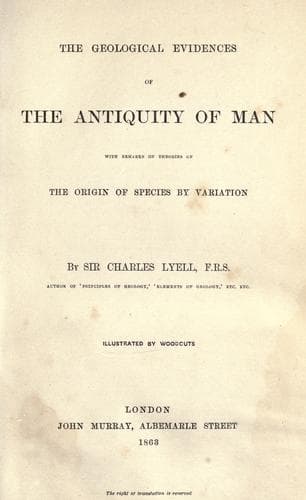
Evolution (Biology); Glacial epoch; Human beings -- Origin; Human evolution
M. Morlot has estimated with care the probable antiquity of three
superimposed vegetable soils cut open at different depths in the delta
of the Tiniere, each containing human bones or works of art, belonging
successively to the Roman, bronze, and later stone periods. According
to his estimate, an antiquity of 7000 years at least must be assigned
to the oldest of these remains, though believed to be long posterior in
date to the time when the mammoth and other extinct mammalia flourished
together with Man in Europe. Such computations of past time must be
regarded as tentative in the present state of our knowledge and much
collateral evidence will be required to confirm them; yet the results
appear to me already to afford a rough approximation to the truth.
Between the newer or Recent division of the stone period and the older
division, which has been called the Pleistocene, there was evidently a
vast interval of time--a gap in the history of the past, into which many
monuments of intermediate date will one day have to be intercalated. Of
this kind are those caves in the south of France, in which M. Lartet
has lately found bones of the reindeer, associated with works of art
somewhat more advanced in style than those of St. Acheul or of Aurignac.
In the valley of the Somme we have seen that peat exists of great
thickness, containing in its upper layers Roman and Celtic memorials,
the whole of which has been of slow growth, in basins or depressions
conforming to the present contour and drainage levels of the country,
and long posterior in date to older gravels, containing bones of the
mammoth and a large number of flint implements of a very rude and
antique type. Some of those gravels were accumulated in the channels
of rivers which flowed at higher levels by 100 feet than the present
streams, and before the valley had attained its present depth and form.
No intermixture has been observed in those ancient river beds of any of
the polished weapons, called "celts," or other relics of the more modern
times, or of the second or Recent stone period, nor any interstratified
peat; and the climate of those Pleistocene ages, when Man was a denizen
of the north-west of France and of southern and central England, appears
to have been much more severe in winter than it is now in the
same region, though far less cold than in the glacial period which
immediately preceded.
Public-domain text, read in full here on John Shaqi.
Reviews
Reviews
No reviews yet
Be the first to share your thoughts on this work.
Elsewhere in the archive
Join the Discussion
Join the discussion
Sign in to leave a comment or review.
Sign InorCreate an account