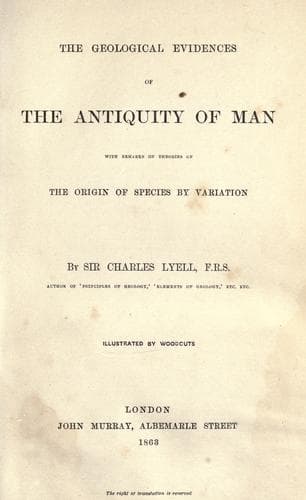
Evolution (Biology); Glacial epoch; Human beings -- Origin; Human evolution
We may presume that the time demanded for the gradual dying out or
extirpation of a large number of wild beasts which figure in the
Pleistocene strata and are missing in the Recent fauna was of protracted
duration, for we know how tedious a task it is in our own times, even
with the aid of fire-arms, to exterminate a noxious quadruped, a wolf,
for example, in any region comprising within it an extensive forest or a
mountain chain. In many villages in the north of Bengal, the tiger still
occasionally carries off its human victims, and the abandonment of late
years by the natives of a part of the Sunderbunds or lower delta of the
Ganges, which they once peopled, is attributed chiefly to the ravages of
the tiger. It is probable that causes more general and powerful than the
agency of Man, alterations in climate, variations in the range of
many species of animals, vertebrate and invertebrate, and of plants,
geographical changes in the height, depth, and extent of land and sea,
some or all of these combined, have given rise in a vast series of
years to the annihilation, not only of many large mammalia, but to the
disappearance of the Cyrena fluminalis, once common in the rivers of
Europe, and to the different range or relative abundance of other shells
which we find in the European drifts.
That the growing power of Man may have lent its aid as the destroying
cause of many Pleistocene species, must, however, be granted; yet,
before the introduction of fire-arms, or even the use of improved
weapons of stone, it seems more wonderful that the aborigines were able
to hold their own against the cave-lion, hyaena, and wild bull, and
to cope with such enemies, than that they failed to bring about their
speedy extinction.
It is already clear that Man was contemporary in Europe with two species
of elephant, now extinct, E. primigenius and E. antiquus, two also of
rhinoceros, R. tichorhinus and R. hemitoechus (Falc.), at least one
species of hippopotamus, the cave-bear, cave-lion, and cave-hyaena,
various bovine, equine, and cervine animals now extinct, and many
smaller Carnivora, Rodentia, and Insectivora. While these were slowly
passing away, the musk ox, reindeer, and other arctic species which have
survived to our times were retreating northwards from the valleys of the
Thames and Seine to their present more arctic haunts.
Public-domain text, read in full here on John Shaqi.
Reviews
Reviews
No reviews yet
Be the first to share your thoughts on this work.
Elsewhere in the archive
Join the Discussion
Join the discussion
Sign in to leave a comment or review.
Sign InorCreate an account