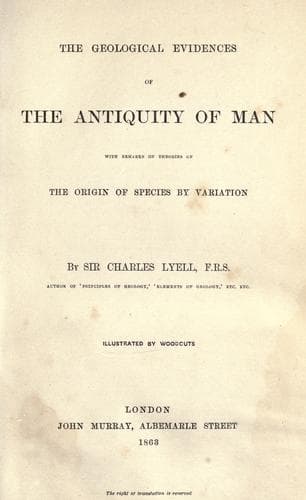
Evolution (Biology); Glacial epoch; Human beings -- Origin; Human evolution
From the time of Linnaeus to the commencement of the present century,
it seemed a sufficient definition of the term species to say that
"a species consisted of individuals all resembling each other, and
reproducing their like by generation." But Lamarck after having
first studied botany with success, had then turned his attention to
conchology, and soon became aware that in the newer (or Tertiary) strata
of the earth's crust there were a multitude of fossil species of shells,
some of them identical with living ones, others simply varieties of the
living, and which as such were entitled to be designated, according
to the ordinary rules of classification, by the same names. He also
observed that other shells were so nearly allied to living forms that
it was difficult not to suspect that they had been connected by a common
bond of descent. He therefore proposed that the element of time should
enter into the definition of a species, and that it should run thus:
"A species consists of individuals all resembling each other, and
reproducing their like by generation, SO LONG AS THE SURROUNDING
CONDITIONS DO NOT UNDERGO CHANGES SUFFICIENT TO CAUSE THEIR HABITS,
CHARACTERS, AND FORMS TO VARY." He came at last to the conclusion that
none of the animals and plants now existing were primordial creations,
but were all derived from pre-existing forms, which, after they may have
gone on for indefinite ages reproducing their like, had at length, by
the influence of alterations in climate and in the animate world been
made to vary gradually, and adapt themselves to new circumstances, some
of them deviating in the course of ages so far from their original type
as to have claims to be regarded as new species.
In support of these views, he referred to wild and cultivated plants and
to wild and domesticated animals, pointing out how their colour, form,
structure, physiological attributes and even instincts were gradually
modified by exposure to new soils and climates, new enemies, modes of
subsistence, and kinds of food.
Nor did he omit to notice that the newly acquired peculiarities may
be inherited by the offspring for an indefinite series of generations,
whether they be brought about naturally--as when a species, on the
extreme verge of its geographical range, comes into competition with
new antagonists and is subjected to new physical conditions; or
artificially--as when by the act of the breeder or horticulturist
peculiar varieties of form or disposition are selected.
Public-domain text, read in full here on John Shaqi.
Reviews
Reviews
No reviews yet
Be the first to share your thoughts on this work.
Elsewhere in the archive
Join the Discussion
Join the discussion
Sign in to leave a comment or review.
Sign InorCreate an account