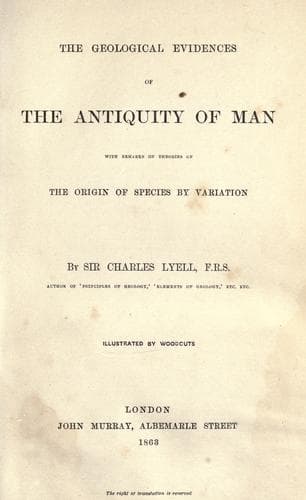
Evolution (Biology); Glacial epoch; Human beings -- Origin; Human evolution
But Lamarck taught not only that species had been constantly undergoing
changes from one geological period to another, but that there also had
been a progressive advance of the organic world from the earliest to
the latest times, from beings of the simplest to those of more and more
complex structure, and from the lowest instincts up to the highest,
and finally from brute intelligence to the reasoning powers of Man. The
improvement in the grade of being had been slow and continuous, and the
human race itself was at length evolved out of the most highly organised
and endowed of the inferior mammalia.
In order to explain how, after an indefinite lapse of ages, so many of
the lowest grades of animal or plant still abounded, he imagined that
the germs or rudiments of living things, which he called monads, were
continually coming into the world and that there were different kinds
of these monads for each primary division of the animal and vegetable
kingdoms. This last hypothesis does not seem essentially different from
the old doctrine of equivocal or spontaneous generation; it is wholly
unsupported by any modern experiments or observation, and therefore
affords us no aid whatever in speculating on the commencement of vital
phenomena on the earth.
Some of the laws which govern the appearance of new varieties were
clearly pointed out by Lamarck. He remarked, for example, that as the
muscles of the arm become strengthened by exercise or enfeebled by
disuse, some organs may in this way, in the course of time, become
entirely obsolete, and others previously weak become strong and play a
new or more leading part in the organisation of a species. And so
with instincts, where animals experience new dangers they become more
cautious and cunning, and transmit these acquired faculties to their
posterity. But not satisfied with such legitimate speculations, the
French philosopher conceived that by repeated acts of volition animals
might acquire new organs and attributes, and that in plants, which
could not exert a will of their own, certain subtle fluids or organising
forces might operate so as to work out analogous effects.
After commenting on these purely imaginary causes, I pointed out in
1832, as the two great flaws in Lamarck's attempt to explain the origin
of species, first, that he had failed to adduce a single instance of
the initiation of a new organ in any species of animal or plant; and
secondly, that variation, whether taking place in the course of nature
or assisted artificially by the breeder and horticulturist, had never
yet gone so far as to produce two races sufficiently remote from each
other in physiological constitution as to be sterile when intermarried,
or, if fertile, only capable of producing sterile hybrids, etc.*
(* "Principles of Geology" 1st edition volume 2 chapter 2.)
Public-domain text, read in full here on John Shaqi.
Reviews
Reviews
No reviews yet
Be the first to share your thoughts on this work.
Elsewhere in the archive
Join the Discussion
Join the discussion
Sign in to leave a comment or review.
Sign InorCreate an account