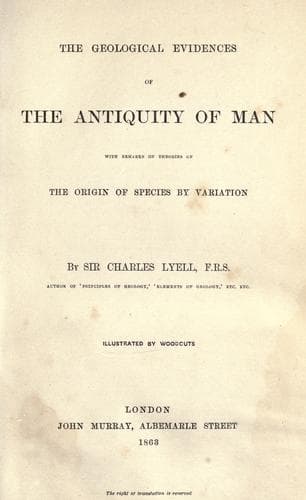
Evolution (Biology); Glacial epoch; Human beings -- Origin; Human evolution
"There are traces," he says, "among the old deposits of the earth of an
organic progression among the successive forms of life. They are to
be seen in the absence of mammalia in the older, and their very
rare appearance in the newer Secondary groups; in the diffusion of
warm-blooded quadrupeds (frequently of unknown genera) in the older
Tertiary system, and in their great abundance (and frequently of known
genera) in the upper portions of the same series; and lastly, in the
recent appearance of Man on the surface of the earth."
"This historical development," continues the same author, of the forms
and functions of organic life during successive epochs, "seems to mark
a gradual evolution of creative power, manifested by a gradual ascent
towards a higher type of being." "But the elevation of the fauna of
successive periods was not made by transmutation, but by creative
additions; and it is by watching these additions that we get some
insight into Nature's true historical progress, and learn that there
was a time when Cephalopoda were the highest types of animal life, the
primates of this world; that Fishes next took the lead, then Reptiles;
and that during the secondary period they were anatomically raised far
above any forms of the reptile class now living in the world. Mammals
were added next, until Nature became what she now is, by the addition of
Man."*
(* Professor Sedgwick's "Discourse on the Studies of the
University of Cambridge" Preface to 5th edition pages 44,
154, 216, 1850.)
Although in the half century which has elapsed between the time of
Lamarck and the publication of the above summary, new discoveries have
caused geologists to assign a higher antiquity both to Man and the
oldest fossil mammalia, fish, and reptiles than formerly, yet the
generalisation, as laid down by the Woodwardian Professor, as to
progression, still holds good in all essential particulars.
The progressive theory was propounded in the following terms by the late
Hugh Miller in his "Footprints of the Creator."
"It is of itself an extraordinary fact without reference to other
considerations, that the order adopted by Cuvier in his "Animal
Kingdom," as that in which the four great classes of vertebrate animals,
when marshalled according to their rank and standing, naturally range,
should be also that in which they occur in order of time. The brain,
which bears an average proportion to the spinal cord of not more than
two to one, comes first--it is the brain of the fish; that which bears
to the spinal cord an average proportion of two and a half to one
succeeded it--it is the brain of the reptile; then came the brain
averaging as three to one--it is that of the bird. Next in succession
came the brain that averages as four to one--it is that of the mammal;
and last of all there appeared a brain that averages as twenty-three to
one--reasoning, calculating Man had come upon the scene."*
Public-domain text, read in full here on John Shaqi.
Reviews
Reviews
No reviews yet
Be the first to share your thoughts on this work.
Elsewhere in the archive
Join the Discussion
Join the discussion
Sign in to leave a comment or review.
Sign InorCreate an account