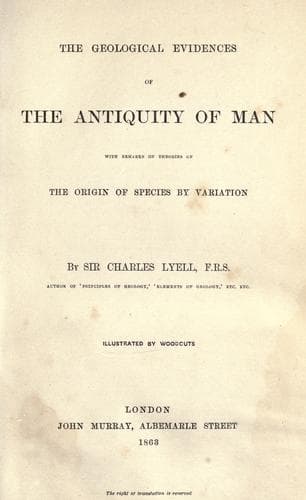
Evolution (Biology); Glacial epoch; Human beings -- Origin; Human evolution
But while rejecting transmutation, I was equally opposed to the popular
theory that the creative power had diminished in energy, or that it
had been in abeyance ever since Man had entered upon the scene. That a
renovating force which had been in full operation for millions of years
should cease to act while the causes of extinction were still in full
activity, or even intensified by the accession of Man's destroying
power, seemed to me in the highest degree improbable. The only point on
which I doubted was whether the force might not be intermittent instead
of being, as Lamarck supposed, in ceaseless operation. Might not the
births of new species, like the deaths of old ones, be sudden? Might
they not still escape our observation? If the coming in of one new
species, and the loss of one other which had endured for ages, should
take place annually, still, assuming that there are a million of animals
and plants living on the globe, it would require, I observed, a million
of years to bring about a complete revolution in the fauna and flora. In
that case, I imagined that, although the first appearance of a new form
might be as abrupt as the disappearance of an old one, yet naturalists
might never yet have witnessed the first entrance on the stage of a
large and conspicuous animal or plant, and as to the smaller kinds, many
of them may be conceived to have stolen in unseen, and to have spread
gradually over a wide area, like species migrating into new provinces.*
(* "Principles of Geology" 1st edition 1832 volume 2 chapter
11; and 9th edition page 706.)
It may now be useful to offer some remarks on the very different
reception which the twin branches of Lamarck's development theory,
namely, progression and transmutation, have met with, and to inquire
into the causes of the popularity of the one and the great unpopularity
of the other. We usually test the value of a scientific hypothesis by
the number and variety of the phenomena of which it offers a fair or
plausible explanation. If transmutation, when thus tested, has decidedly
the advantage over progression and yet is comparatively in disfavour,
we may reasonably suspect that its reception is retarded, not so much by
its own inherent demerits, as by some apprehended consequences which
it is supposed to involve and which run counter to our preconceived
opinions.
THEORY OF PROGRESSION.
In treating of this question, I shall begin with the doctrine of
progression, a concise statement of which, so far as it relates to the
animal kingdom, was thus given twelve years ago by Professor Sedgwick,
in the preface to his "Discourse on the Studies of the University of
Cambridge."
Public-domain text, read in full here on John Shaqi.
Reviews
Reviews
No reviews yet
Be the first to share your thoughts on this work.
Elsewhere in the archive
Join the Discussion
Join the discussion
Sign in to leave a comment or review.
Sign InorCreate an account