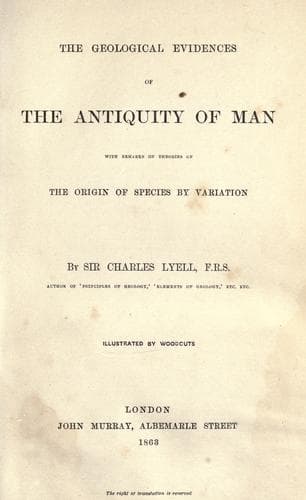
Evolution (Biology); Glacial epoch; Human beings -- Origin; Human evolution
He does not pretend to trace an exact historical series from the
sea-weed to the fern, or from the fern again to the conifers and
cycads, and lastly from those families to the palms and oaks, but he,
nevertheless, points out that the cryptogamic forms, especially the
acrogens, predominate among the fossils of the primary formations,
the Carboniferous especially, while the gymnosperms or coniferous and
cycadeous plants abound in all the strata, from the Trias to the Wealden
inclusive; and lastly, the more highly developed angiosperms, both
monocotyledonous and dicotyledonous, do not become abundant until the
Tertiary period. It is a remarkable fact, as he justly observes,
that the angiospermous exogens, which comprise four-fifths of living
plants--a division to which all our native European trees, except the
Coniferae, belong, and which embrace all the Compositae, Leguminosae,
Umbelliferae, Cruciferae, Heaths, and so many other families--are wholly
unrepresented by any fossils hitherto discovered in the Primary and
Secondary formations from the Silurian to the Oolitic inclusive. It is
not till we arrive at the Cretaceous period that they begin to appear,
sparingly at first, and only playing a conspicuous part, together with
the palms and other endogens, in the Tertiary epoch.
When commenting on the eagerness with which the doctrine of progression
was embraced from the close of the last century to the time when I first
attempted, in 1830, to give some account of the prevailing theories in
geology, I observed that far too much reliance was commonly placed on
the received dates of the first appearances of certain orders or classes
of animals or plants, such dates being determined by the age of the
stratum in which we then happened to have discovered the earliest
memorials of such types. At that time (1830), it was taken for granted
that Man had not co-existed with the mammoth and other extinct mammalia,
yet now that we have traced back the signs of his existence to the
Pleistocene era, and may anticipate the finding of his remains on some
future day in the Pliocene period, the theory of progression is not
shaken; for we cannot expect to meet with human bones in the Miocene
formations, where all the species and nearly all the genera of mammalia
belong to types widely differing from those now living; and had some
other rational being, representing Man, then flourished, some signs
of his existence could hardly have escaped unnoticed, in the shape of
implements of stone or metal, more frequent and more durable than the
osseous remains of any of the mammalia.
Public-domain text, read in full here on John Shaqi.
Reviews
Reviews
No reviews yet
Be the first to share your thoughts on this work.
Elsewhere in the archive
Join the Discussion
Join the discussion
Sign in to leave a comment or review.
Sign InorCreate an account