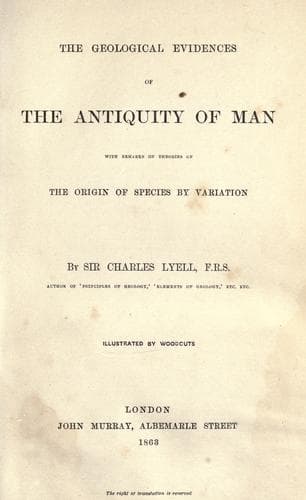
Evolution (Biology); Glacial epoch; Human beings -- Origin; Human evolution
In the beginning of this century it was one of the canons of the popular
geological creed that the first warm-blooded quadrupeds which had
inhabited this planet were those derived from the Eocene gypsum of
Montmartre in the suburbs of Paris, almost all of which Cuvier had shown
to belong to extinct genera. This dogma continued in force for more than
a quarter of a century, in spite of the discovery in 1818 of a marsupial
quadruped in the Stonesfield strata, a member of the Lower Oolite,
near Oxford. Some disputed the authority of Cuvier himself as to the
mammalian character of the fossil; others, the accuracy of those who had
assigned to it so ancient a place in the chronological series of rocks.
In 1832 I pointed out that the occurrence of this single fossil in
the Oolite was "fatal to the theory of successive development" as then
propounded.*
(* "Principles of Geology" 2nd edition 1 173.)
Since that period great additions have been made to our knowledge of
the existence of land quadrupeds in the olden times. We have ascertained
that, in Eocene strata older than the gypsum of Paris, no less than
four distinct sets of placental mammalia have flourished; namely, first,
those of the Headon series in the Isle of Wight, from which fourteen
species have been procured; secondly, those of the antecedent
Bagshot and Bracklesham beds, which have yielded, together with the
contemporaneous "calcaire grossier" of Paris, twenty species; thirdly,
the still older beds of Kyson, near Ipswich, and those of Herne Bay,
at the mouth of the Thames, in which seven species have been found;
and fourthly, the Woolwich and Reading beds, which have supplied ten
species.*
(* Lyell's supplement to 5th edition of "Elements" 1857.)
We can scarcely doubt that we should already have traced back the
evidence of this class of fossils much farther had not our inquiries
been arrested, first by the vast gap between the Tertiary and Secondary
formations, and then by the marine nature of the Cretaceous rocks.
The mammalia next in antiquity, of which we have any cognisance, are
those of the Upper Oolite of Purbeck, discovered between the years 1854
and 1857, and comprising no less than fourteen species, referable
to eight or nine genera; one of them, Plagiaulax, considered by Dr.
Falconer to have been a herbivorous marsupial. The whole assemblage
appear, from the joint observations of Professor Owen and Dr. Falconer,
to indicate a low grade of quadruped, probably of the marsupial type.
They were, for the most part, diminutive, the two largest not much
exceeding our common hedgehog and polecat in size.
Public-domain text, read in full here on John Shaqi.
Reviews
Reviews
No reviews yet
Be the first to share your thoughts on this work.
Elsewhere in the archive
Join the Discussion
Join the discussion
Sign in to leave a comment or review.
Sign InorCreate an account