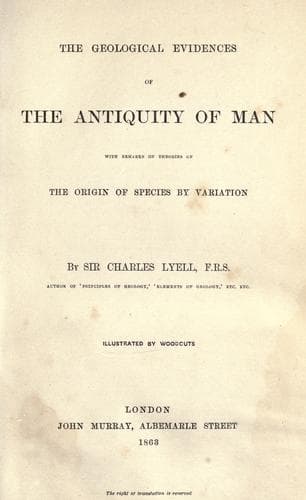
Evolution (Biology); Glacial epoch; Human beings -- Origin; Human evolution
Next anterior in age are the mammalia of the Lower Oolite of
Stonesfield, of which four species are known, also very small and
probably marsupial, with one exception, the Stereognathus ooliticus,
which, according to Professor Owen's conjecture, may have been a hoofed
quadruped and placental, though, as we have only half of the lower jaw
with teeth, and the molars are unlike any living type, such an opinion
is of course hazarded with due caution.
Still older than the above are some fossil quadrupeds of small size,
found in the Upper Trias of Stuttgart in Germany, and more lately by Mr.
C. Moore in beds of corresponding age near Frome, which are also of a
very low grade, like the living Myrmecobius of Australia. Beyond this
limit our knowledge of the highest class of vertebrata does not as
yet extend into the past, but the frequent shifting back of the old
landmarks, nearly all of them once supposed in their turn to indicate
the date of the first appearance of warm-blooded quadrupeds on this
planet, should serve as a warning to us not to consider the goal at
present reached by palaeontology as one beyond which they who come after
us are never destined to pass.
On the other hand, it may be truly said in favour of progression that
after all these discoveries the doctrine is not gainsaid, for the less
advanced marsupials precede the more perfect placental mammalia in the
order of their appearance on the earth.
If the three localities where the most ancient mammalia have been
found--Purbeck, Stonesfield, and Stuttgart--had belonged all of them to
formations of the same age, we might well have imagined so limited an
area to have been peopled exclusively with pouched quadrupeds, just
as Australia now is, while other parts of the globe were inhabited by
placentals, for Australia now supports one hundred and sixty species of
marsupials, while the rest of the continents and islands are tenanted by
about seventeen hundred species of mammalia, of which only forty-six
are marsupial, namely, the opossums of North and South America. But the
great difference of age of the strata in each of these three localities
seems to indicate the predominance throughout a vast lapse of time (from
the era of the Upper Trias to that of the Purbeck beds) of a low grade
of quadrupeds; and this persistency of similar generic and ordinal types
in Europe while the species were changing, and while the fish, reptiles,
and mollusca were undergoing vast modifications, raises a strong
presumption that there was also a vast extension in space of the same
marsupial forms during that portion of the Secondary epoch which has
been termed "the age of reptiles."
Public-domain text, read in full here on John Shaqi.
Reviews
Reviews
No reviews yet
Be the first to share your thoughts on this work.
Elsewhere in the archive
Join the Discussion
Join the discussion
Sign in to leave a comment or review.
Sign InorCreate an account