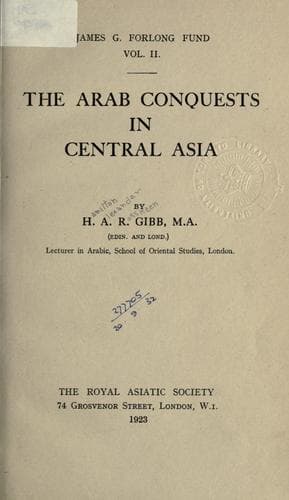
The Arab conquests in Central AsiaGibb, H. A. R. (Hamilton Alexander Rosskeen)
Islamic
The Arab conquests in Central Asia
Gibb, H. A. R. (Hamilton Alexander Rosskeen)
Bukhoro (Uzbekistan) -- History; Islamic Empire; Khanate of Bukhara -- History
For a moment the hopes of a radical change of policy entertained by the
mawālī and the clearer-sighted Arabs were raised to the highest pitch by
the appointment (in 109) of Ashras b. ʿAbdullah as-Sulami, accompanied by
the separation of Khurāsān from Khālid al-Qasrī’s province of ʿIrāq. It
is unnecessary to recapitulate here the far-reaching concessions by which
he hoped to secure, and actually did for a time secure the allegiance of
the _S_ughdians, or the methods by which the local princes, especially
Ghūrak, succeeded in checking the movement[83]. It is generally assumed
that the hostility of Ghūrak was due to the serious fall in revenue
which would result. Though this was doubtless the plea put forward and
accepted by Ashras it can scarcely have been the true issue. Ghūrak’s
aim was not to maintain himself on good terms with the Arab governors
but to recover his independence. If once the people became “Arabs” all
hope of success must have been lost. It was a game with high stakes and
Ghūrak won. It must not be overlooked, however, that the account as we
have it is traditional and may often be mistaken on the sequence of
cause and effect. The astonishing reversal of the measures adopted by
Ashras is more probably to be explained by pressure from above, not from
below, and our tradition may really present only the popular view of
the Caliph Hishām’s reorganization of the financial administration[84].
The Arabs resorted to brutal methods to wring the taxes from the new
converts, and with incredible blindness selected the dihqāns for
special indignities. It is not unlikely that Narshakhī’s story of the
martyrdom of native Muslims in Bukhārā is connected with this event,
though there are many other possible explanations, such as, for example,
an attempted _H_ārithite movement (see below, p. 76 f.) The reaction
swung the whole population of Transoxania, dihqāns and peasantry alike,
into open rebellion. The first small party of emigrants who quitted
Samarqand, although supported by a few Arabs, were induced to surrender
and return[85], but within a few months the dreaded Khāqān with his
Türgesh had joined forces with the rebels and swept the Arabs across the
Oxus. Even Bukhārā was lost[86] and only Samarqand with two minor posts
on the Zarafshān, Kamarja and Dabūsia, held out. Ghūrak, however, still
supported the Arabs, as Samarqand, although besieged, seems to have been
in no danger, while his son Mukhtār, doubtless to keep a footing in the
opposite camp, joined with the Türgesh.
Public-domain text, read in full here on John Shaqi.
Reviews
Reviews
No reviews yet
Be the first to share your thoughts on this work.
Elsewhere in the archive
Join the Discussion
Join the discussion
Sign in to leave a comment or review.
Sign InorCreate an account