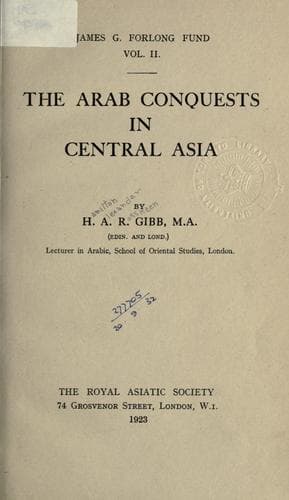
The Arab conquests in Central AsiaGibb, H. A. R. (Hamilton Alexander Rosskeen)
Islamic
The Arab conquests in Central Asia
Gibb, H. A. R. (Hamilton Alexander Rosskeen)
Bukhoro (Uzbekistan) -- History; Islamic Empire; Khanate of Bukhara -- History
The pressing danger sobered the Arabs and temporarily united all parties
and factions. The army was concentrated at Āmul but for three months was
unable to cross the river in the face of the combined native and Türgesh
armies. A small body under Qa_t_an b. Qutayba which had already crossed
and fortified itself before the arrival of the Turks was beleaguered. The
Turkish cavalry even made raids on Khurāsān with an excess of boldness
which was punished by a mounted force under Thābit Qu_t_na. At length
Ashras got his forces across and, joining with Qa_t_an b. Qutayba,
advanced on Paykand. The enemy cut off the water supply, and had it not
been for the gallantry and self-sacrifice of _H_ārith b. Surayj, Thābit
Qu_t_na, and their companions, an even greater and more irretrievable
“Day of Thirst” had resulted. In spite of their weakness, Qa_t_an and the
cavalry of Qays and Tamīm charged the enemy and forced them back, so that
Ashras was able to continue his advance towards Bukhārā. In the heavy
fighting the Muslim forces were divided, Ashras and Qa_t_an gave each
other up for lost, and Ghūrak judged that the time had come to throw in
his lot with the Turks. Two days later, however, the armies were reunited
and on the retiral of the Turks encamped at Bawādara outside the walls of
Bukhārā, whence they prepared to besiege the city. Ghūrak also retrieved
his error and rejoined Ashras. The Khāqān withdrew towards Samarqand,
but sat down before Kamarja, expecting to take it by storm in a few
days at the most. The Arabic narratives of these events are confused in
several places, which has given rise to many incorrect statements, such
as that Ghūrak was beleaguered with the Arabs in Kamarja and that the
garrison consisted of Qa_t_an and his forces. Kamarja was not in the
neighbourhood of Paykand, as Wellhausen states, but a few farsakhs west
of Samarqand[87]. When the garrison would not yield to assault Khāqān
tried other methods. Accompanying his expedition was Khusrū the son of
Pērōz and grandson of Yazdigird, heir of the Sāsānid kings. This prince
was sent to parley with the garrison, but when he claimed the restoration
of his kingdom and promised them an amnesty, it is not surprising that
the Arabs indignantly refused to hear him. Nor would the appearance of a
Sāsānid prince evoke much enthusiasm amongst the Iranians of Transoxania.
As the Sāsānid house had taken refuge in China, however, the presence of
Khusrū might be taken as an indication that the rebels were receiving
encouragement from China also, though the Chinese records are silent on
this expedition. Khāqān’s second proposal, that he should hire the Arabs
as mercenaries, was rejected as derisively as the first. The siege was
then pressed with renewed vigour, both sides putting their prisoners and
hostages to death, but after fifty-eight days Khāqān, on the advice of
the son of Ghūrak and the other _S_ughdian princes, allowed the garrison
to transfer either to Samarqand or Dabūsia.
Public-domain text, read in full here on John Shaqi.
Reviews
Reviews
No reviews yet
Be the first to share your thoughts on this work.
Elsewhere in the archive
Join the Discussion
Join the discussion
Sign in to leave a comment or review.
Sign InorCreate an account