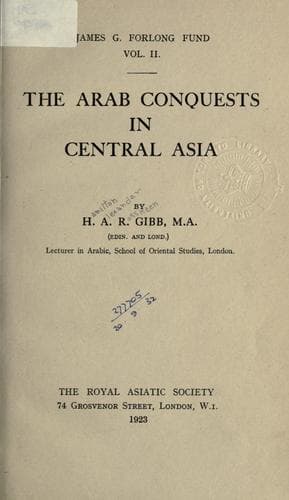
The Arab conquests in Central AsiaGibb, H. A. R. (Hamilton Alexander Rosskeen)
Islamic
The Arab conquests in Central Asia
Gibb, H. A. R. (Hamilton Alexander Rosskeen)
Bukhoro (Uzbekistan) -- History; Islamic Empire; Khanate of Bukhara -- History
The year after the campaigns against _H_ārith, 118/736, was devoted by
Asad to the re-organisation of his province, including a measure which,
it seems, he had already projected in his first term of office. This was
the removal of the provincial capital from Merv to Balkh[92]. Since no
other governor of Khurāsān followed his example we must seek the motive
for the innovation either in the contemporary situation in Khurāsān
and Transoxania or in Asad’s personal views. Explanations based on the
former are not hard to find. Asad, on taking office, had been faced with
a serious situation both in Lower _T_ukhāristān and across the river. He
had obviously to establish a strong point _d’appui_. The loyalty of the
garrison at Merv was not above suspicion but the garrison at Balkh was
composed of Syrian troops, who could be trusted to the uttermost[93].
Merv was also less convenient for reaching _T_ukhāristān, which was at
the moment the main area of operations. More important still, perhaps,
Balkh was the centre from which all disturbances spread in Eastern
Khurāsān, as in the revolt of Nēzak and the recent attempt of _H_ārith.
As the holding of Balkh had enabled Qutayba to forestall Nēzak, it is
possible that Asad felt that in Balkh he would be in a position to check
all similar movements at the beginning. Other considerations may also
have disposed him to take this view. Balkh was the traditional capital
and on it, as we have seen, was focussed the local sentiment of Eastern
Khurāsān. Merv, on the other hand, had always been the capital of the
foreigners, of the Sāsānians before the Arabs. Asad’s personal friendship
with the dihqāns may have given him some insight into the moral effect
which would follow from the transference of the administration to the
centre of the national life. Still greater would this effect be when the
rebuilding was carried out not by the Arabs themselves but by their own
people under the supervision of the Barmak, the hereditary priest-ruler
of the ancient shrine. Quite apart from this, however, the rebuilding
of Balkh was an event of the greatest significance, and once restored
it soon equalled, if it did not eclipse, its rival Merv in size and
importance. While the new city was being built, the army was employed in
expeditions into _T_ukhāristān, for the most part under the command of
Judayʿ al-Karmānī, who achieved some successes against the followers of
_H_ārith and even succeeded in capturing their fortress in Badakhshān.
Other raids were undertaken by the governor himself, but without results
of military importance.
Public-domain text, read in full here on John Shaqi.
Reviews
Reviews
No reviews yet
Be the first to share your thoughts on this work.
Elsewhere in the archive
Join the Discussion
Join the discussion
Sign in to leave a comment or review.
Sign InorCreate an account