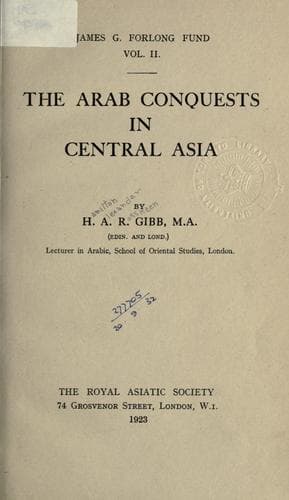
The Arab conquests in Central AsiaGibb, H. A. R. (Hamilton Alexander Rosskeen)
Islamic
The Arab conquests in Central Asia
Gibb, H. A. R. (Hamilton Alexander Rosskeen)
Bukhoro (Uzbekistan) -- History; Islamic Empire; Khanate of Bukhara -- History
“Then Asad marched towards Samarqand by way of Zamm, and when
he reached Zamm, he sent to Al-Haytham ash-Shaybānī, one of
_H_ārith’s followers, who was in Bādhkar (the citadel of Zamm),
saying “That which you have disowned in your own people is only
their evil ways, but that does not extend to the women ...
_nor to the conquest by the unbelievers of such as Samarqand_.
Now I am on my way to Samarqand and I take an oath before God
that no harm shall befall you on my initiative, but you shall
have friendly and honourable treatment and pardon, you and
those with you....” So Al-Haytham came out to join him on the
condition of pardon which he had given him, and Asad pardoned
him, and Al-Haytham marched with him to Samarqand and Asad gave
them double pay.”
The expedition therefore was obviously against unbelievers. That the
whole of _S_ughd was lost to the Arabs is clear from the fact that Asad
found it necessary to take provisions for the army with him from Bukhārā.
He was not successful in recapturing the city, however, and attempted no
more than the damming of the canal sluices at Waraghsar.
The fate of the garrison of Samarqand has thus been passed over in
silence, unless, perhaps, it is hinted at in Asad’s reference to the
capture of Muslim women. Whether Ghūrak recaptured it with his own troops
or with the aid of the Türgesh, it can scarcely be doubted that he had
taken advantage of the dissensions in Khurāsān to realise his ambition
and at last drive the Arabs out of his capital. Of all the conquests
of Qutayba beyond the Oxus, Bukhārā, Chaghāniān, and perhaps Kish
alone remained to the Arabs. A confirmatory detail is the cessation of
_S_ughdian embassies to China between 731 and 740: now that independence
(even if under Türgesh suzerainty) had been won again, there was no need
to invoke Chinese support. Negative evidence of the same kind is afforded
by the absence of any Arab embassy during the same period. Had the Arabs
been in possession of _S_ughd, it is practically certain that Asad,
as he had done before, would have renewed relations with the Chinese
court. Against this view may be set the statement in _T_ab. 1613. 5 that
Khāqān was preparing an army to invest Samarqand at the time of his
assassination. This report is, however, from its nature untrustworthy,
and is contradicted by the presence of the king of _S_ughd with
_S_ughdian troops in the Türgesh army in 119/737 as well as by Na_s_r b.
Sayyār’s expedition to Samarqand two years later. _S_ughd thus enjoyed
once more a brief period of independence. In 737 or 738 Ghūrak died and
his kingdom was divided amongst his heirs. He was succeeded at Samarqand
by his son Tu-ho (? _T_arkhūn), formerly prince of Kabudhān. Another son
Me-chuʾo (? Mukhtār) was already king of Māyamurgh, while the king of
Ishtīkhan in 742 was a certain Ko-lo-pu-lo who may perhaps be identified
with Ghūrak’s brother Afarūn[91].
Public-domain text, read in full here on John Shaqi.
Reviews
Reviews
No reviews yet
Be the first to share your thoughts on this work.
Elsewhere in the archive
Join the Discussion
Join the discussion
Sign in to leave a comment or review.
Sign InorCreate an account