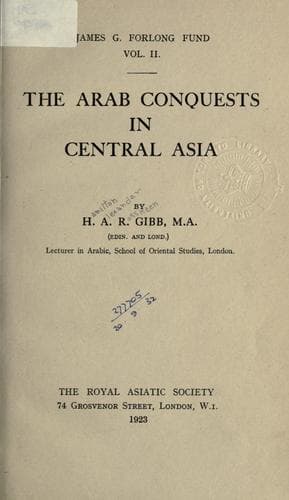
The Arab conquests in Central AsiaGibb, H. A. R. (Hamilton Alexander Rosskeen)
Islamic
The Arab conquests in Central Asia
Gibb, H. A. R. (Hamilton Alexander Rosskeen)
Bukhoro (Uzbekistan) -- History; Islamic Empire; Khanate of Bukhara -- History
to withdraw to Balkh without further serious fighting. A variant account
given by _T_abarī relates an unsuccessful assault by the Türgesh on
Asad’s camp on the morning following the “Battle of the Baggage,” which
happened to be the feast of Fi_t_r (1st October 737). On the retiral of
the Arabs, the Khāqān, instead of returning to his capital with the
honours of the day, remained in _T_ukhāristān.
Here he was joined by _H_ārith, who advised him to undertake a winter
raid into Lower _T_ukhāristān while the Arab troops were disbanded,
undoubtedly in the expectation that the local princes would again unite
with him against Asad. The governor retained his army at Balkh until
the winter had set in, and in the meantime the Khāqān summoned forces
to join him from _S_ughd and the territories subject to _T_ukhāristān.
The enumeration which _T_abarī gives of the troops accompanying the
Khāqān on this expedition shows very clearly how completely Arab rule in
Transoxania and the Oxus basin had been supplanted by that of the Turks.
We are told that besides the Khāqān’s own Turkish troops and _H_ārith
with his followers there were present the Jabghu, the king of _S_ughd,
the prince of Usrūshana, and the rulers of Shāsh and Khuttal. It is
fairly certain, of course, that the list is exaggerated in so far as the
actual presence of the princes is concerned (it is in fact partially
contradicted in other parts of the narrative), but it can scarcely be
doubted that forces from some, if not all, of these principalities
were engaged. On the evening of the 9th Dhuʾl-_H_ijja (7th Dec.) news
reached Balkh that the Türgesh with their auxiliaries, numbering some
30,000, were at Jazza. Asad ordered signal fires to be lit and with the
Syrian garrison of Balkh and what other troops he could muster from
the district marched out against them. The governor of Khulm sent in a
second report that the Khāqān, having been repulsed in an attack on the
town, had marched on towards Pērōz Nakhshēr, in the neighbourhood of
Balkh. From this point the enemy, avoiding Balkh, moved on Jūzjān and
occupied the capital[96]. Instead of continuing his advance immediately,
the Khāqān halted here and sent out raiding parties of cavalry in all
directions, an action which put it beyond doubt that the immediate object
of the expedition was not the capture of Merv but the rousing of Lower
_T_ukhāristān against the Arabs. Contrary to _H_ārith’s expectations,
however, the king of Jūzjān joined with the Arabs, who marched towards
Shubūrqān by way of Sidra and Kharīstān. From the conflicting narratives
in _T_abarī, it seems that Asad surprised the Khāqān in the neighbourhood
of Kharīstān (or Sān) at a moment when his available forces amounted only
to 4,000. A furious struggle ensued, which was decided in favour of the
Arabs by an assault on the Khāqān from the rear, on the initiative of the
king of Jūzjān. It is in connection with the battle, which he describes
Public-domain text, read in full here on John Shaqi.
Reviews
Reviews
No reviews yet
Be the first to share your thoughts on this work.
Elsewhere in the archive
Join the Discussion
Join the discussion
Sign in to leave a comment or review.
Sign InorCreate an account