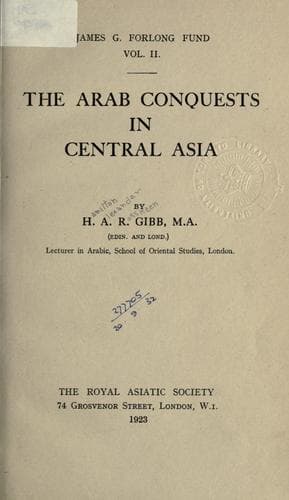
The Arab conquests in Central AsiaGibb, H. A. R. (Hamilton Alexander Rosskeen)
Islamic
The Arab conquests in Central Asia
Gibb, H. A. R. (Hamilton Alexander Rosskeen)
Bukhoro (Uzbekistan) -- History; Islamic Empire; Khanate of Bukhara -- History
as if it were a set engagement in which the whole of the opposing forces
were engaged, that _T_abarī gives his list of the combatants. But as only
4,000 out of the total of 30,000 troops with the Khāqān were involved,
the list is obviously out of place and the whole narrative shows the
marks of rehandling. The Muslims gained an overwhelming success: the
Khāqān and _H_ārith, having narrowly escaped capture in the confusion,
were closely followed by Asad as far as Jazza, when a storm of rain and
snow prevented further pursuit. They were thus able to regain the Jabghu
in _T_ukhāristān, with happier fortune than the raiding parties, whose
retreat was cut off by the vigilance of Al-Karmānī, and of whom only a
single band of _S_ughdians made good their escape.
On this skirmish at Kharīstān, for it was little more, hung the fate of
Arab rule, not only in Transoxania, but possibly even in Khurāsān, at
least for the immediate future. Though the princes of Lower _T_ukhāristān
fought for Asad in the first place, there can be little doubt that a
victory for Su-Lu would have swung them back to the side of _H_ārith
and the Turks, who would then have been in a position to follow up
their attacks with the advantage of a base at Balkh, solidly supported
by the Oxus provinces. From such a danger the Arabs were saved only by
Asad’s resolution and fortunate selection of Balkh as his residence. The
account given of Hishām’s incredulity on hearing the report shows how
very serious the outlook had been and the extent to which the name of
the Khāqān had become an omen of disaster. Kharīstān was not only the
turning point in the fortunes of the Arabs in Central Asia, but gave the
signal for the downfall of the Türgesh power, which was bound up with the
personal prestige of Su-Lu. The princes of _T_ukhāristān and Transoxania
found it expedient to treat him with respect as he was returning to
Nawākath, but in his own country the dissensions long fomented in secret
by the Chinese broke out. Su-Lu was assassinated by the Baga Tarkhan
(Kūr_s_ūl); the kingdom fell to pieces. “The Turks split up and began to
raid one another,” and the _coup de grâce_ of the Khanate was delivered
at Sūyāb in 739 by the faction of Kūr_s_ūl, supported by the Chinese
and with the assistance of Al-Ishkand and contingents from Shāsh and
Farghāna[97][98]. With the collapse of the Türgesh kingdom disappeared
the last great Turkish confederation in Western Asia for more than two
centuries to come. The battle of Kharīstān assured the supremacy of
the Muslim civilisation in Sogdiana, but it could not have attained
the richness of its full development there unless all danger from the
steppes had been removed. That this security was attained was due not
to the Arabs, but to the Chinese diplomacy, which, by breaking down the
greatest external obstacle to the Muhammadan penetration of Central Asia,
brought itself face to face with the Arabs. This could scarcely have been
Public-domain text, read in full here on John Shaqi.
Reviews
Reviews
No reviews yet
Be the first to share your thoughts on this work.
Elsewhere in the archive
Join the Discussion
Join the discussion
Sign in to leave a comment or review.
Sign InorCreate an account