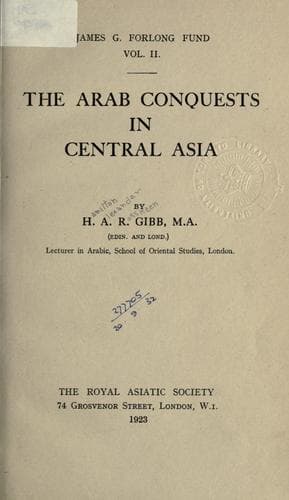
The Arab conquests in Central AsiaGibb, H. A. R. (Hamilton Alexander Rosskeen)
Islamic
The Arab conquests in Central Asia
Gibb, H. A. R. (Hamilton Alexander Rosskeen)
Bukhoro (Uzbekistan) -- History; Islamic Empire; Khanate of Bukhara -- History
realised at once, however, by the Arab government, whose immediate task
was to restore its lost authority in Transoxania.
NOTES
[74] As the history of this and the following period has been given
in considerable detail by Wellhausen (Arab. Reich 280 ff.) from the
Arab point of view, it is intended in these chapters to follow only
the situation in Transoxania and the course of the Türgesh conquests,
avoiding as far as possible a simple recapitulation of familiar matter.
Thus little reference is made to the factional strife among the Arabs,
though it naturally played a very important part in limiting their power
to deal with the insurgents.
[75] See Chavannes, Documents 285, n. 3.
[76] _Cf._ _T_ab. II. 1718. 3 ff.
[77] _T_ab. 1462. 11; _cf._ 1688. 10, 1481 f.
[78] _T_ab. 1690. 16.
[79] Chav. Doc. 206 f., 293 f.
[80] Van Vloten, La Domination Arabe 28.
[81] _T_ab. 1533. 15.
[82] _T_ab. 1501. 2.
[83] Wellhausen 284 f.: van Vloten 22 f.: _T_ab. 1507 f.: Bal. 428 f.
[84] See Wellhausen 218.
[85] The variant readings in _T_ab. 1509. 11. (_cf._ Ibn al-Athīr) make
it doubtful whether the taxes were reimposed on them or not.
[86] _T_ab. 1514. 11.
[87] See Yāqūt s.v.: Barthold, Turkestan 127: and _cf._ _T_ab. 1523. 3.
The chief difficulty in _T_abarī’s text is the abrupt change at the last
word of l. 14 on p. 1516: thumma ta_h_awwala (ashrashu) ilā marjin yuqālu
lahu bawādaratun _faʿatāhum_ sabābatun ... wahum nuzūlun bikamarjata.
The context shows that it was not to Ashras that Sabāba came but to the
garrison of Kamarja with the news that the Khāqān was retiring past them
(mārrun bikum).
[88] The chronological difficulties are explained by Wellhausen 285 ff.
They are of small importance however, and it seems preferable to follow
his dates for these campaigns.
[89] _Cf._ _T_ab. 1528. 9. with 1529. 5 f. 14 f.
[90] Van Vloten, _op. cit._ 29 ff.: Wellhausen 289 ff. (_cf._ 302 f.).
Another account of _H_ārith is given by Gardīzī ap. Barthold Turkestan,
Texts pp. 1-2.
[91] Chav. Doc. 210, 136, 140; Barthold, Arab. Quellen 21. n. 8.
[92] _T_ab. 1490, 1591. 18: Wellhausen 292 and 284 n.: Barthold in
Zeitschrift für Assyriologie XXVI (1911) 261.
[93] _T_ab. 1590. 5. There does not seem to be any record of when these
Syrians were settled at Balkh.
[94] Wieger 1643: Chav. Doc. 284 f.
[95] Chav. Doc. 168.
[96] As Jūzjān is distinguished from Shubūrqān in _T_ab. 1608. 17, it
is probable that this was the town Kundurm or Qurzumān mentioned in
Yaʿqūbī’s Geog. 287.
[97] _T_ab. 1613: Chav. Doc. 83 f., 122 n. As regards the adjective
Kharlukhī applied to the Jabghu in 1612. 16, the most satisfactory
explanation is that given by Marquart, Hist. Glossen 183 f.
Public-domain text, read in full here on John Shaqi.
Reviews
Reviews
No reviews yet
Be the first to share your thoughts on this work.
Elsewhere in the archive
Join the Discussion
Join the discussion
Sign in to leave a comment or review.
Sign InorCreate an account