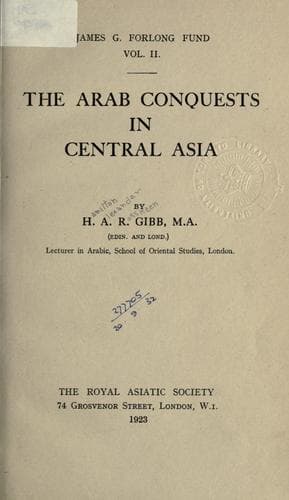
The Arab conquests in Central AsiaGibb, H. A. R. (Hamilton Alexander Rosskeen)
Islamic
The Arab conquests in Central Asia
Gibb, H. A. R. (Hamilton Alexander Rosskeen)
Bukhoro (Uzbekistan) -- History; Islamic Empire; Khanate of Bukhara -- History
The reaction produced by the downfall of the Türgesh power was manifested
in Transoxania in the first place by an increased regard for China. The
princes had found the Türgesh yoke no less galling in the end than that
of the Arabs[99]; the country was as wasted and impoverished by their
continual raids as it had been under the latter. The profitable native
and transit trade, the source of the entire wealth of the cities, must
have shrunk to negligible proportions if it had not wholly ceased. All
classes of the people therefore were weary of war and sought only a
peace consonant with their self-respect. For the attainment of these
aims it was vain to look to China; the granting of bombastic titles
to a few princes brought neither comfort nor aid. A final opportunity
was thus offered to wise statesmanship to swing the whole country
round to the Arabs almost without a blow. For two years, however, the
situation seemed to remain much as it was, except for an expedition into
Khuttal, probably on the pretext of assisting the ruling house against
a usurper from Bamiyān. Nevertheless some progress had been made by the
administration in regaining the prestige it had lost. This was due not
merely to the effect of the victories over _H_ārith and the Türgesh, but
even more to Asad’s personal relations with the dihqāns. He had, as we
have seen, gratified the national pride of the people of _T_ukhāristān by
transferring the seat of power from Merv, the capital of the foreigners,
to Balkh, the centre of their national life. As had been the case even
in his first term of office, he was able to attract to his side many of
the more influential elements in Lower _T_ukhāristān and the Ephthalite
lands—to this, in fact, was largely due his success in the struggle with
the Turks. More striking evidence still is afforded by the conversion of
the dihqāns at this period, amongst them the minor chief Sāmān-Khudāh and
probably also the Barmak. By this means Asad laid the foundations for a
true reconciliation and Narshakhī’s work amply attests the honour which
later generations attached to his name. His work was of course incomplete
in that it was practically confined to the ruling classes and naturally
did not extend to the now independent dihqāns of _S_ughd.
Public-domain text, read in full here on John Shaqi.
Reviews
Reviews
No reviews yet
Be the first to share your thoughts on this work.
Elsewhere in the archive
Join the Discussion
Join the discussion
Sign in to leave a comment or review.
Sign InorCreate an account