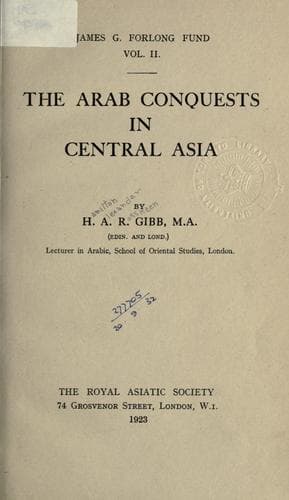
The Arab conquests in Central AsiaGibb, H. A. R. (Hamilton Alexander Rosskeen)
Islamic
The Arab conquests in Central Asia
Gibb, H. A. R. (Hamilton Alexander Rosskeen)
Bukhoro (Uzbekistan) -- History; Islamic Empire; Khanate of Bukhara -- History
Early in 120/738 Asad died, and after a lapse of some months the
governorship was conferred by Hishām on Na_s_r b. Sayyār. For the subject
peoples no choice could have been more opportunely made. Na_s_r was
one of the few men who had come with honour and reputation through the
external and internal conflicts of the last thirty years. Belonging
to the small and almost neutral tribe of Kināna, his position bore a
strong similarity to that of Qutayba in that both were more dependent on
the support of a powerful patron than on their tribal connexions, and
therefore, though favouring Qays, less frantically partisan. In contrast
to Qutayba, however, Na_s_r, after thirty years of active leadership,
knew the situation in Khurāsān, Transoxania, and Central Asia as no
Arab governor had ever done. He had seen the futility of trying to hold
the country by mere brute force, and the equal futility of trying to
dispense with force. While he held the support of Hishām, therefore, he
set himself to restore Arab authority in Transoxania. The appointment
of Qa_t_an b. Qutayba, who had inherited much of his father’s ability,
to command the forces beyond the river gave earnest of an aggressive
policy. The appointment was not to Samarqand, as Wellhausen says, but
“over _S_ughd,” _i.e._, the garrisons in Bukhārā and probably Kish, who
were responsible in the first place for keeping the surrounding districts
in subjection. The governor himself then carried out a brief expedition,
intended apparently to punish some rebels in the neighbourhood of the
Iron Gate, possibly in Shūmān. Having thus vindicated the authority of
the administration, Na_s_r returned to Merv and delivered the famous
Khu_t_ba in which the system of taxation and conditions of amnesty were
at last laid down in a form satisfactory to the mawālī and the subject
peoples[100]. The results were as he had foreseen. The princes and people
of Transoxania submitted, as far as we can judge, without opposition when
Na_s_r with his army marched through _S_ughd to re-establish the Arab
garrison and administration in Samarqand.
Public-domain text, read in full here on John Shaqi.
Reviews
Reviews
No reviews yet
Be the first to share your thoughts on this work.
Elsewhere in the archive
Join the Discussion
Join the discussion
Sign in to leave a comment or review.
Sign InorCreate an account