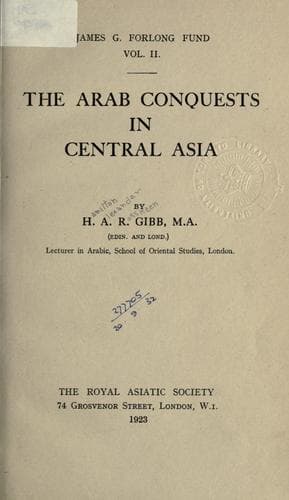
The Arab conquests in Central AsiaGibb, H. A. R. (Hamilton Alexander Rosskeen)
Islamic
The Arab conquests in Central Asia
Gibb, H. A. R. (Hamilton Alexander Rosskeen)
Bukhoro (Uzbekistan) -- History; Islamic Empire; Khanate of Bukhara -- History
It is not surprising, however, that the princes were dissatisfied with
the success which had attended the pacification of Transoxania. The
people were “becoming Arabs” too rapidly and their own authority was
menaced in consequence. They were still hopeful of regaining their
independence, especially when Na_s_r’s position became less secure after
the death of Hishām. We hear therefore of sporadic embassies to China,
such as that sent from Ishtīkhan in 745 asking for annexation to China
“like a little circumscription.” That the governor was aware of this
undercurrent may be judged from the fact that he felt it necessary to
have _H_ārith b. Surayj pardoned, in case he should again bring in the
Turks to attack the government[107]. But the people as a whole held
for Na_s_r. The respect and even affection which he inspired held all
Transoxania true to him during the last troubled years. No tribute could
be more eloquent than the facts that not a single city in Transoxania
took advantage of the revolutionary movements in Khurāsān to withdraw
its allegiance, that Abū Muslim’s missionaries went no further than
the Arab colonies at Āmul, Bukhārā, and Khwārizm, and that the loyal
garrison of Balkh found first support and then refuge in Chaghāniān and
_T_ukhāristān. On these facts the various authorities whose narratives
are related by _T_abarī completely agree, and by their agreement
disprove the exaggerated account given by Dīnawarī (359 f.) that “Abū
Muslim sent his envoys (duʿāt) to all quarters of Khurāsān, and the
people rallied _en masse_ to Abū Muslim from Herāt, Būshanj, Merv-Rūdh,
_T_ālaqān, Merv, Nasā, Abīward, _T_ūs, Naysābūr, Sarakhs, Balkh,
Chaghāniān, _T_ukhāristān, Khuttalān, Kish, and Nasaf.” Dīnawarī himself
states a little later that Samarqand joined Abū Muslim only after the
death of Na_s_r. Abū Muslim’s main strength, in fact, was drawn from
Lower _T_ukhāristān and the neighbourhood of Merv-Rūdh, several of the
princes of which, including the ruler of Būshanj and Khālid b. Barmak,
declared for him. But even here the people were not solidly against
the administration. We are told that a camp was established at Jīranj
(south of Merv) “to cut off the reinforcements of Na_s_r b. Sayyār from
Merv-Rūdh, Balkh, and the districts of (Lower) _T_ukhāristān.” Herāt fell
to Abū Muslim by force of arms. The Syrian garrison of Balkh, together
with the Mu_d_arite party, were supported by the rulers of both Upper and
Lower _T_ukhāristān, and twice recaptured the city from their stronghold
at Tirmidh. An example of Abū Muslim’s efforts to gain over the Iranians
is afforded by an incident when, having taken 300 Khwārizmian prisoners
in an engagement, he treated them well and set them free[108].
Public-domain text, read in full here on John Shaqi.
Reviews
Reviews
No reviews yet
Be the first to share your thoughts on this work.
Elsewhere in the archive
Join the Discussion
Join the discussion
Sign in to leave a comment or review.
Sign InorCreate an account