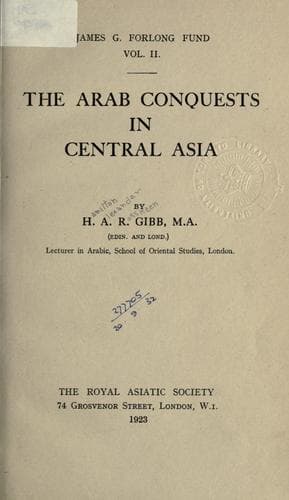
The Arab conquests in Central AsiaGibb, H. A. R. (Hamilton Alexander Rosskeen)
Islamic
The Arab conquests in Central Asia
Gibb, H. A. R. (Hamilton Alexander Rosskeen)
Bukhoro (Uzbekistan) -- History; Islamic Empire; Khanate of Bukhara -- History
The tradition of the enthusiasm of the Iranians for Abū Muslim is true
only of the period after his success. In our most authentic records there
is no trace of a mass movement such as has so often been portrayed. His
following was at first comparatively so small that had the Arabs been
more willing to support Na_s_r at the outset, it is practically certain
that it would have melted away as rapidly as the following of _H_ārith
b. Surayj at the first reverse. “Nothing succeeds like success,” and
Abū Muslim, once victorious on so imposing a scale, and that with the
aid of Iranians, became a heroic figure among the peoples of Eastern
Khurāsān. The legend penetrated but slowly into Transoxania. When by
130/748, however, the whole of Eastern Khurāsān had fallen to Abū Muslim
and Na_s_r no longer held authority, his governors in Transoxania were
replaced by the nominees of Abū Muslim without outward disturbance. But
the recrudescence of embassies to China shows that under the surface
currents were stirring. Shāsh had already thrown off its allegiance
and the Sogdian princes had by no means lost all hope of regaining
independence in spite of the tranquillity of the last few years. As it
happened, however, the first revolt was not on their part but by the Arab
garrison of Bukhārā under Sharīk b. Shaykh in 133/750-751. The rising,
which was due to their resentment at the seizure of the Caliphate by the
ʿAbbāsids and the passing over of the ʿAlid house, was suppressed with
some difficulty by Abū Muslim’s lieutenant Ziyād b. Sāli_h_ assisted by
the Bukhār Khudāh. The fact that the Bukhār-Khudāh assisted the troops
of Abū Muslim against Sharīk might be regarded as an indication that
he belonged to the party of the former. This inference is more than
doubtful, however. Of the 30,000 men, who, we are told, joined the
rebels, probably the greater part were the townsmen, or “popular party,”
of Bukhārā. The revolt thus assumed the domestic character of a movement
against the aristocratic party, who, led by the Bukhār-Khudāh, naturally
cooperated with the Government in its suppression. The events of the
following year are sufficient evidence against any other explanation.
According to Narshakhī, who gives by far the fullest account of this
revolt, Ziyād had also to suppress a similar movement in Samarqand. In
the same year an expedition was sent into Khuttal by Abū Dāwud, the
governor of Balkh. Al-_H_anash at first offered no opposition; later in
the campaign he attempted to hold out against the Arabs but was forced
to fly to the Turks and thence to China where he was given the title of
Jabghu in recompense for his resistance[109]. By this expedition Khuttal
was effectively annexed to the Arab government for the first time.
Public-domain text, read in full here on John Shaqi.
Reviews
Reviews
No reviews yet
Be the first to share your thoughts on this work.
Elsewhere in the archive
Join the Discussion
Join the discussion
Sign in to leave a comment or review.
Sign InorCreate an account