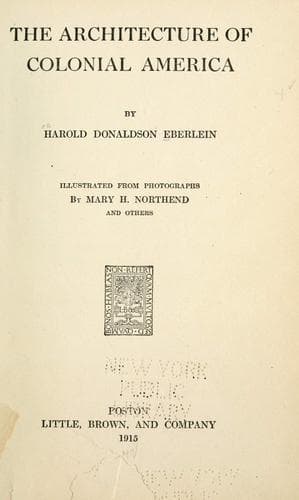
The Architecture of Colonial AmericaEberlein, Harold Donaldson
History
The Architecture of Colonial America
Eberlein, Harold Donaldson
Architecture -- United States; Architecture, Colonial
The influence of the Classic Revival was to be noted earliest in public
edifices such as the Boston State House on Beacon Hill, the New Theatre
or the Bank of the United States in Philadelphia or, most of all, in the
Capitol at Washington in the design, erection and restoration or
rebuilding of which so many of the most eminent architects of the day
had a share. There the classic orders were reproduced with faithful
accuracy in combinations that displayed their chaste beauty and noble
proportions in the most dignified and impressive manner. Capitals of
impeccable exactitude and fidelity to their prototypes, pediments and
entablatures of due proportion, triglyphs, mutules, modillion brackets,
acanthus leaves, egg and dart mouldings, dentils, anthemia and all the
other structural and ornamental features characteristic of either Greek
or Roman architecture became familiar objects to the public gaze and
exercised their subtle but powerful agency in the education of a
disciplined and elegant sense of architectural propriety.
The architecture of the Classic Revival was undoubtedly at its best in
public edifices or in large and imposing mansions which afforded
sufficient opportunity to display its ample characteristics. Such
structures, moreover, did not require any great stretch of ingenuity in
making adaptations. While columns might have to be lengthened out or
features foreign to classic conception added, the task of accommodation
rarely offered serious difficulties to be overcome. In the hands of such
men as Bulfinch or McIntire, at the outset, or of Latrobe, Hoban,
Strickland and their various able contemporaries, the Classic Revival
gave us many truly admirable structures instinct with dignity and grace.
In the hands of the too confident and insufficiently educated mechanic
who ventured to try his hand at designing, it was a very different thing
indeed and its remaining examples of this inferior type can scarcely be
viewed with pleasure.
Public-domain text, read in full here on John Shaqi.
Reviews
Reviews
No reviews yet
Be the first to share your thoughts on this work.
Elsewhere in the archive
Join the Discussion
Join the discussion
Sign in to leave a comment or review.
Sign InorCreate an account