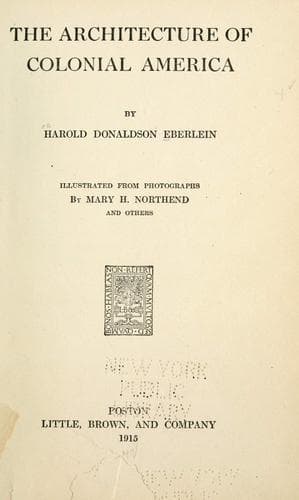
The Architecture of Colonial AmericaEberlein, Harold Donaldson
History
The Architecture of Colonial America
Eberlein, Harold Donaldson
Architecture -- United States; Architecture, Colonial
Along with Bulfinch, as a representative of the transition stage, must
be classed Samuel McIntire, of Salem, whose work both public and
domestic has always been justly esteemed. He, too, retained a large
share of Adam elegance and wealth of detail which he successfully
incorporated with motifs and methods of treatment inspired by the more
recent impetus of classicism. To McIntire’s influence may be attributed
much of the slender delicacy of proportion and the attenuation of
pillars and pilasters--this attenuation had a counterpart in some of the
contemporary New York Dutch design--so noticeable in a great deal of New
England architecture of this period. He eliminated all grossness and
pared down the dimensions of columns while he drew out their length to a
degree that had no precedent in ancient practice and would have shocked
the French purists under whose auspices the new movement
[Illustration: ANDREW SAFFORD PORCH, SALEM, MASS.
Transition to Classic Revival.]
[Illustration: INTERIOR DOORWAY, NICHOLS HOUSE, SALEM, MASS.]
[Illustration:
Photograph by C. V. Buck, from Underwood & Underwood, N. Y.
THE CAPITOL AT WASHINGTON.
Classic Revival.]
[Illustration: GIRARD COLLEGE, PHILADELPHIA.
Classic Revival.]
had been inaugurated. Despite these departures from architectural and
archæological orthodoxy, however, McIntire’s work is replete with
exquisite charm and is justified by applying to it the touchstone of
good taste.
Latrobe, McComb, in his later work, L’Enfant, Hoban, Dr. Thornton,
Thomas Jefferson, Strickland and other noted architects of the last
years of the eighteenth century and the fore part of the nineteenth
followed classic precedent somewhat more closely in the practice of
their profession and may, therefore, be considered the most faithful and
typical exponents of Classic Revival principles. Much of their work is
noble in conception and peculiarly suited to the monumental character of
the buildings they designed.
Public-domain text, read in full here on John Shaqi.
Reviews
Reviews
No reviews yet
Be the first to share your thoughts on this work.
Elsewhere in the archive
Join the Discussion
Join the discussion
Sign in to leave a comment or review.
Sign InorCreate an account