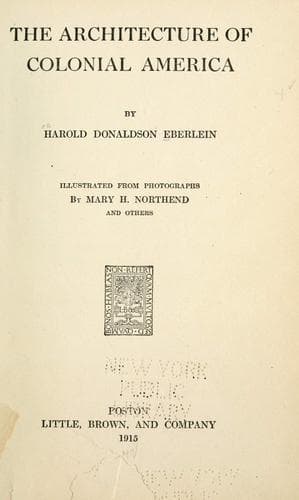
The Architecture of Colonial AmericaEberlein, Harold Donaldson
History
The Architecture of Colonial America
Eberlein, Harold Donaldson
Architecture -- United States; Architecture, Colonial
State House group, the two buildings projecting farther toward the
street than the rest, are decent in appearance but quite unpretentious.
Of exterior architectural embellishments, such as the State House can
boast, they are innocent, save the cupolas, which are good. Inside, the
woodwork detail is pleasing. The western building, Congress Hall, was
erected in 1788; here Washington’s second inauguration took place and
here John Adams was inducted into office as President. The eastern
building, intended for the City Hall, was built in 1791. While
Philadelphia was the seat of national government it was turned over to
the Supreme Court of the United States and here presided Chief Justices
John Jay, John Rutledge and Oliver Ellsworth.
In New England, the most impressive secular public buildings are the Old
State House in Boston, built in 1728, Faneuil Hall, built in 1741, and
the Bulfinch State House, on the summit of Beacon Hill, built in 1795.
The Old State House, a structure of peculiarly pleasing proportions and
admirable poise, is thoroughly representative of the best Georgian
feeling of the period of its erection both in manner of construction and
detail. Its square lantern of three stages is particularly interesting
as are also the stepped gables at each end, with the carved figures of
the British lion and unicorn apparently stationed as heraldic
supporters of the ornate apex with the clock. On account of these
stepped gables the criticism has sometimes been advanced that the Old
State House shows traces of Dutch influence in its design. While it is
quite true that stepped gables are characteristic of many Dutch
buildings, the attribution of Dutch influence in the treatment of the
Old State House can scarcely be justified for there is nowhere else
observable any suggestion of Dutch tendencies and the precedent for
stepped gables in unmistakably English work of an earlier date is by no
means wanting. Rich in historic memories, of which, perhaps, the Boston
Massacre stands forth most vividly, it is deservedly cherished with
civic pride as the ancient centre of Provincial life and it is
gratifying to see how punctiliously and accurately it has been restored
to its pristine condition under the able direction of Joseph Everett
Chandler, to whose enthusiasm are due many other faithful restorations
of seventeenth and eighteenth century New England architectural
treasures.
Faneuil Hall, hard by, also worthily upholds the Georgian traditions of
the mid-eighteenth century in its storeyed façades, its gracefully
proportioned and detailed cupola and the excellence of its interior
cornices, pillars and carved capitals. This “cradle of American liberty”
is a truly noble building and a worthy setting for the stirring
historic episodes that have been enacted beneath its roof or under the
shadow of its walls.
Public-domain text, read in full here on John Shaqi.
Reviews
Reviews
No reviews yet
Be the first to share your thoughts on this work.
Elsewhere in the archive
Join the Discussion
Join the discussion
Sign in to leave a comment or review.
Sign InorCreate an account