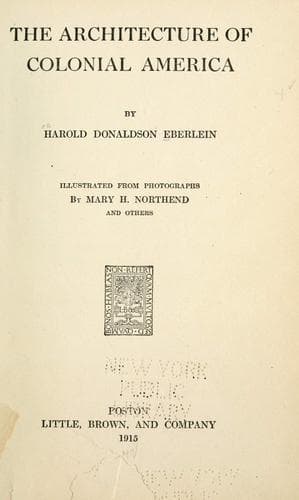
The Architecture of Colonial AmericaEberlein, Harold Donaldson
History
The Architecture of Colonial America
Eberlein, Harold Donaldson
Architecture -- United States; Architecture, Colonial
To this Southwark theatre repaired all the wealth, beauty and fashion of
Philadelphia, at that time the metropolis of the Colonies. There, until
1773, the “American Company” had its regular season and, despite Quaker
hostility, Philadelphia was the most important theatrical centre of all
the Colonial cities. During the acute troubles with the Mother Country
prior to the outbreak of the Revolution and while that struggle was in
progress the old stock company was driven from Philadelphia as most of
its members were loyal British subjects. While the British occupation of
Philadelphia lasted, Lord Howe’s officers gave amateur performances in
the Southwark theatre, devoting the proceeds to the benefit of the
“widows and orphans of the army.” The unfortunate Major André took an
active part in these dramatic efforts, and not only acted but assisted
in painting the scenery, and one drop curtain, bearing his name as
artist, was used until it was destroyed by a disastrous fire in 1821.
This circumstance and the fact that General Washington during his
residence in Philadelphia, as President of the United States, frequently
attended the performances, occupying one of the stage boxes above which
the arms of the United States had replaced those of Great Britain, have
lent an unusual interest to this first permanent American theatre. It
was a rectangular building with a low pitched gable end towards the
street front and devoid of any architectural pretension save three round
headed windows above the door and a modest cupola on the ridge of the
roof. Only the north wall of the old building still stands and is
incorporated in the fabric of a distillery which occupies the site of
the theatre.
In 1793, Charles Bulfinch built the first theatre in Boston and, in
1794, the “New Theatre” was opened in Philadelphia, at Sixth and
Chestnut streets. It was designed in a far more pretentious and stately
manner than the old Southwark theatre and showed the coming influence of
the Classic Revival. In front was a long, pillared portico or arcade and
the whole façade displayed a good deal of architectural enrichment of a
formal kind. It may be regarded as thoroughly typical of the new
architectural tendencies and representative of the best sort of
play-houses that were erected for a number of years thereafter.
Public-domain text, read in full here on John Shaqi.
Reviews
Reviews
No reviews yet
Be the first to share your thoughts on this work.
Elsewhere in the archive
Join the Discussion
Join the discussion
Sign in to leave a comment or review.
Sign InorCreate an account