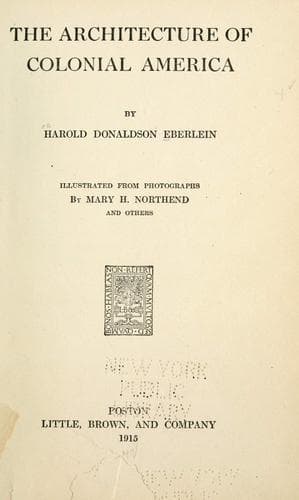
The Architecture of Colonial AmericaEberlein, Harold Donaldson
History
The Architecture of Colonial America
Eberlein, Harold Donaldson
Architecture -- United States; Architecture, Colonial
In city churches, because of the greater number of important folk,
questions of precedence in seating were more perplexing than in the
country. At Annapolis in St. Anne’s, in Christ Church at Philadelphia
and also in the “court churches” in New York and Boston the Royal
Governours’ pews were marked by appropriate symbols of the majesty of
state, the royal arms carved in walnut that once hung above the
Lieutenant Governour’s seat being still preserved at Christ Church in
Philadelphia. The lesser dignitaries sat in due order becoming their
station.
In New England it seems to have been the general custom in the earlier
period for the men to sit on one side of the church and the women on the
other. Afterwards, families sat together. In order to avoid bickering
and contention about the order of precedence it was not an unusual thing
to appoint a committee to “dignify the meeting.” The members of these
committees were changed from time to time “in order to obviate any of
the effects of partiality through kinship, friendship, personal esteem
or debt.” A second committee was appointed to seat the members of the
first committee according to their proper rank. In her charming book,
“The Sabbath in Puritan New England,” Alice Morse Earle says:--
“Sometimes a row of square pews was built on three sides of the
ground floor, and each pew occupied by separate families, while the
pulpit was on the fourth side. If any man wished such a private pew
for himself and family, he obtained permission from the church and
town, and built it at his own expense. Immediately in front of the
pulpit was either a long seat or a square enclosed pew for
[Illustration: OLD SOUTH CHURCH, BOSTON. 1730.]
[Illustration: KING’S CHAPEL, BOSTON.]
[Illustration: CHRIST CHURCH, PHILADELPHIA. 1727.]
[Illustration: ST. PETER’S CHURCH, PHILADELPHIA. 1761.]
the deacons, who sat facing the congregation. This was usually a
foot or two above the level of the other pews, and was reached by
two or three steep, narrow steps. On a still higher plane was a pew
for the ruling elders, when ruling elders there were. The
magistrates also had a pew for their special use. What we now deem
the best seats, those in the middle of the church, were in olden
times, the free seats.”
“In front, on either side of the pulpit (or very rarely in the
foremost row in the gallery), was a seat of highest dignity, known
as the ‘fore seat,’ in which only the persons of greatest
importance in the community sat.”
Not only in New England, but in the other Colonies as well, seats and
pews in the galleries seem to have been preferred as the most desirable
by persons of quality and consideration in the community next to the
specially exalted seats belowstairs.
Public-domain text, read in full here on John Shaqi.
Reviews
Reviews
No reviews yet
Be the first to share your thoughts on this work.
Elsewhere in the archive
Join the Discussion
Join the discussion
Sign in to leave a comment or review.
Sign InorCreate an account