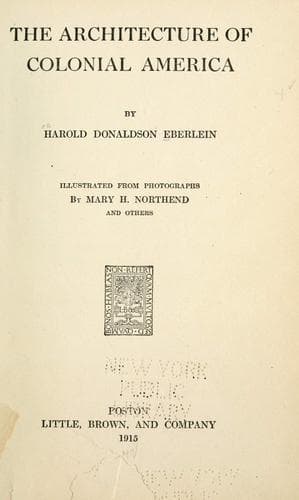
The Architecture of Colonial AmericaEberlein, Harold Donaldson
History
The Architecture of Colonial America
Eberlein, Harold Donaldson
Architecture -- United States; Architecture, Colonial
From considerations of date and geography, our attention is next claimed
by the group of small churches in the Middle Colonies which may be
represented by the Gloria Dei (Old Swedes), Philadelphia, St. David’s,
Radnor, and Trinity, Oxford. The present structure of the Gloria Dei was
built in 1700 to replace the old block house, built in 1665, which had
afforded a place of worship for the congregation since 1677. Seen from
the exterior, the church is cruciform in plan with an apsidal east end.
At the west end is a small, sharp pointed belfry surmounting a
projection in front of the church which is carried up to the peak of the
roof somewhat in the manner of a tower, the lower part forming a
vestibule. The roof is exceedingly steep in pitch and, by the same
token, thereby exhibits the Swedish origin of its plan. The apsidal east
end also indicates its Swedish origin for both the steep pitched roof
and the apse were thoroughly characteristic of the Scandinavian
ecclesiastical edifices. The brick is laid in Flemish bond, the headers,
which seem to have been the arch bricks in the kiln, being covered with
a vitreous blue black glaze. At several places an interesting diaper
pattern is worked in the walls by the ingenious use of these glazed
headers. The great square windows are filled with heavy muntined sashes
and small panes of glass. It was found at an early date that the side
walls were being pushed over by the thrust of the roof and to brace them
the transepts, which do not appear in the interior plan, were built
about 1703, giving the building its cruciform appearance. The south
transept is a vestibule or porch while the north transept is used as a
sacristy. The ceiling is vaulted. North and south galleries date from an
early period but were built somewhat later than the rest of the
structure. The details of panelling and woodwork are of distinctly
pre-Georgian affinities.
Public-domain text, read in full here on John Shaqi.
Reviews
Reviews
No reviews yet
Be the first to share your thoughts on this work.
Elsewhere in the archive
Join the Discussion
Join the discussion
Sign in to leave a comment or review.
Sign InorCreate an account