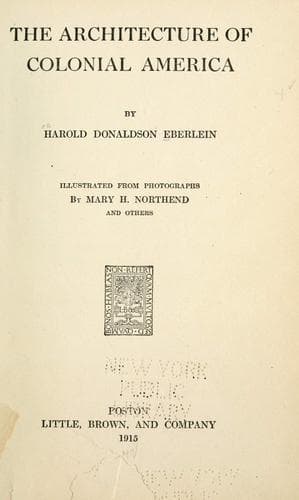
The Architecture of Colonial AmericaEberlein, Harold Donaldson
History
The Architecture of Colonial America
Eberlein, Harold Donaldson
Architecture -- United States; Architecture, Colonial
St. David’s, Radnor, was built in 1714 and seems to have been the result
of the efforts of local artisans without much attempt at architectural
direction or planning. It is extremely simple in every way. In plan it
is rectangular with a later addition at one side to accommodate the
vestry room. The organ gallery is at one end and is reached by an
outside enclosed stone stairway. The roof is of steep pitch and the
cornices are severely plain. The round headed windows are now filled
with small panes set in broad muntins but, if we may believe tradition,
they were originally filled with diamond paned leaded casements. Perhaps
the most interesting architectural feature of St. David’s is the texture
of the stone work in its rubble walls which are built of random sized
native field stone and pointed with white mortar. This masonry is
thoroughly representative of the traditional manner of building stone
walls which the Welsh artisans seem to have brought with them from their
Cambrian home and which has left such a strong impress upon the stone
work of so many of the old houses in Pennsylvania. It is one of the
clearest instances of the survival in America of methods of
craftsmanship brought from specific localities in the old world.
Trinity Church, Oxford, was built in 1711 and is mentioned here chiefly
because it exhibits a more ambitious plan in its original design, having
transepts in the interior which greatly add to its seating capacity and
carry out the cruciform idea both within and without. Its details of
design, masonry and woodwork display an affinity with the earliest phase
of Georgian work.
Christ Church, Philadelphia, to which we now come, stands for all that
is best in church architecture of the Colonial period in America. The
present building was erected in 1727 from plans prepared by Dr. John
Kearsley who seems to have drawn his inspiration largely from St.
Martin’s-in-the-Fields, London. From whatever source his inspiration
came, Christ Church is a peculiarly beautiful and graceful structure,
well meriting all the praise that has been bestowed upon it and
incidentally affording a striking instance of what might be achieved by
the amateur architects of the eighteenth century who believed that a
knowledge of architecture was an essential part of every gentleman’s
education and who were willing to put aside their own professional
vocations for a time in order to plan and superintend the erection of
some public structure as a kind of public duty.
Public-domain text, read in full here on John Shaqi.
Reviews
Reviews
No reviews yet
Be the first to share your thoughts on this work.
Elsewhere in the archive
Join the Discussion
Join the discussion
Sign in to leave a comment or review.
Sign InorCreate an account