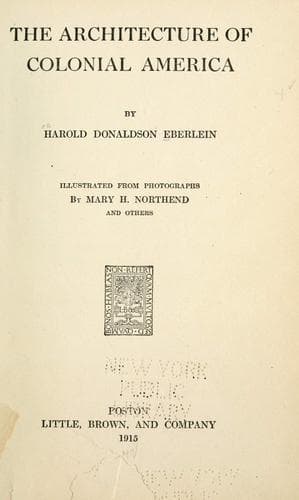
The Architecture of Colonial AmericaEberlein, Harold Donaldson
History
The Architecture of Colonial America
Eberlein, Harold Donaldson
Architecture -- United States; Architecture, Colonial
In Pennsylvania we find masonry of singular excellence and beauty where,
again, both field stone and quarried stone were made use of. The
Pennsylvania rubble masonry, laid by workmen who were merely
perpetuating the traditions they had brought with them from England and
Wales, has always commanded admiration and, in the vicinity of
Philadelphia, the same inherited masonry traditions are still
flourishing vigorously. These rubble walls were sometimes laid with
stones of random sizes, sometimes with stones of comparatively uniform
dimensions. In a few instances, notably in the neighbourhood of
Kingsessing, Philadelphia, and in the walls of Belmont, Fairmount Park,
Philadelphia, once the home of the witty Judge Peters of Revolutionary
fame, the old English custom of galleting the wide, white mortar joints
with little spawls was practised. It was not infrequently the case that
houses would have walls of dressed and squared stone in front with
rubble walls at the sides and rear. Some few, such as Cliveden in
Germantown, Philadelphia, and Whitby Hall, Kingsessing, Philadelphia,
were built of cut stone all the way about. Whitby Hall and a few other
houses also furnish interesting examples of brick door and window trims
that project slightly beyond the face of the stone wall. This
Pennsylvania stone work displayed practically no attempts at carving and
the one instance where it has been carved is found in the window trims
and Ionic capitals of the river front of the Bartram house, Kingsessing,
Philadelphia.
In connexion with Colonial stonework must be mentioned the coating of
walls with stucco and roughcast which were either allowed to remain
their natural colour or whitewashed, as at Wyck, Germantown,
Philadelphia. The very early houses were not stuccoed at first and the
stucco seems to have been added later as a protection, partly, against
the weather where porous stone had been used for the walls, such as some
of the grey stone quarried in the neighbourhood of the Whitemarsh
Valley. The mica stone, so abundant in Pennsylvania, after a few years’
exposure, becomes impervious to moisture and never needs stucco
protection. Oftentimes stucco or roughcast were applied from choice and
not from necessity, especially among the German colonists who seem to
have been chiefly responsible for the introduction of the practice. For
the sake of finish, contrast and cleanly appearance the stucco or
roughcast coat was often whitewashed or yellow washed.
Much of the mortar in the early Colonial period was of poor quality and
rapidly disintegrated. Lime, however, was soon to be had. In some cases
it was imported, in others it was burned wherever limestone or oyster
shells were to be had and the quality of the mortar was very generally
improved throughout the Colonies. Some of it was exceptionally fine and
to-day is as hard as the bricks or stone it binds together.
Public-domain text, read in full here on John Shaqi.
Reviews
Reviews
No reviews yet
Be the first to share your thoughts on this work.
Elsewhere in the archive
Join the Discussion
Join the discussion
Sign in to leave a comment or review.
Sign InorCreate an account