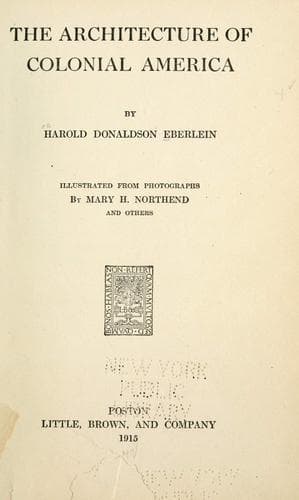
The Architecture of Colonial AmericaEberlein, Harold Donaldson
History
The Architecture of Colonial America
Eberlein, Harold Donaldson
Architecture -- United States; Architecture, Colonial
The panelling in many of the old Colonial houses, and for that matter
the same thing may be said with perfect truth of much of the panelling
to be found in houses of the Georgian type, exhibits marked
irregularities. Although the almost mediæval methods of the early
craftsmen were gradually supplanted by other ways of treating the
material, there was always a delightful personal element of originality
and lack of symmetry in the panelling and woodwork generally. It is this
very originality that gives it its charm and interest. It is precisely
like the features of the human face. If all the features of any human
face were absolutely symmetrical and regular, so that both sides were
precisely alike in every measurement, the countenance would be truly
imbecile in expression. It is the irregularity which causes the outward
indications of character and gives whatever beauty or the opposite
quality there may be. The early craftsmen had no compunction in making
one panel deeper than another, being governed therein by expediency, the
width of the piece they were using, or the distance to be covered. It
was not that they did not do their work well and in a workmanlike
manner, but they saw no reason why they should be tied down by a slavish
exactitude in the exercise of their craft, and they accordingly took
liberties for which we in our slavishly mechanical days may be truly
thankful, and from which we may learn a valuable lesson if we will only
use our eyes and not be afraid to act with a little independence.
CHAPTER XIV
EARLY AMERICAN ARCHITECTS AND THEIR RESOURCES
Who lived in our old houses and what manner of men they were, we
fortunately know. At any rate it is an easy matter to find out. Who
planned and built those houses we do not, as a rule, know nor will the
most careful search and enquiry always bring to light even the name of
the architect or, if they do succeed in doing so much, the information
gained is generally so meagre that it does but whet the appetite for
more. However, regardless of what we may or may not be able to learn of
the designer of this or that house or public building, we shall be quite
safe in attributing the design of early American structures to the
agency of one or the other of three classes of men. This triple division
consisted, first, of amateur architects; second, of carpenter architects
and, last of all, of professional architects. In this grouping, the
professional architect is given the last place because he was least
frequently represented. The first and second classes were by far the
most numerous and some of our best eighteenth century buildings, houses,
churches and other public structures alike, are the results of
collaboration between them.
Public-domain text, read in full here on John Shaqi.
Reviews
Reviews
No reviews yet
Be the first to share your thoughts on this work.
Elsewhere in the archive
Join the Discussion
Join the discussion
Sign in to leave a comment or review.
Sign InorCreate an account