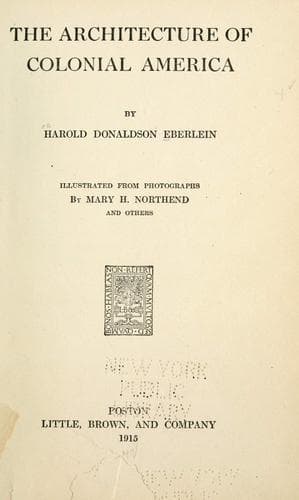
The Architecture of Colonial AmericaEberlein, Harold Donaldson
History
The Architecture of Colonial America
Eberlein, Harold Donaldson
Architecture -- United States; Architecture, Colonial
We shall not be far wrong in ascribing seventeenth century buildings,
almost without exception, to the capable and resourceful craftsman who
not only preserved conscientiously the traditions he had learned as an
apprentice or journeyman in the Mother Country and faithfully
perpetuated them by his practice as a master carpenter or joiner in a
new land but also showed himself possessed of ready wit and keen
perceptive faculties by the alacrity with which he modified and adapted
traditional methods and precedents to new conditions and requirements of
climate and environment. So far as he could consistently do so, he held
by preference to tradition in plan, methods of construction and choice
of materials. When necessity or common sense, however, dictated a
departure from established usage he was quick enough to follow the
promptings of expediency and devise satisfactory substitutes for the
deficiencies of past practice. Hence were originated local types without
any conscious attempt on the part of the agents to be original.
The methods followed by the seventeenth century American builder showed
a close relationship with the practices of mediæval joiners and masons.
Furthermore, these early workmen showed an all-round mastery of their
own craft, an intelligent understanding of related crafts and a thorough
knowledge of the properties and uses of materials that their modern
successors would do well to emulate. They respected their calling and
took a proper pride in the excellence of their craftsmanship. Hence the
work of their hands, however plain and simple, still possesses a dignity
and honest beauty that plainly proclaim how they put their hearts into
what they were doing and, at the same time, command our reverence and
admiration. The old buildings have lasted so well and assumed such an
atmosphere of grace because the artisans acted upon the principle that
what was worth doing at all was worth doing well and set much store by
honest workmanship instead of regarding their occupation as a job to be
got through with at a maximum of wage for a minimum of time spent in
labour. They got the best out of their materials because they knew and
respected the peculiar qualities of their materials. Whether English or
Dutch, Welsh or Swedish, the handiwork of these seventeenth century
builders, wholly without pretence as it was, expressed faithfully the
aggregate of the contemporary phases of the domestic architecture in the
countries whence they came and also evidences both the beginnings and
development of our own several vernacular manifestations, all of which,
to a certain degree, were obscured and discounted by the expansion and
increasing popularity of eighteenth century Georgian modes. To the
carpenter-architects of the seventeenth century we owe a great debt of
gratitude for their faithful preservation of time-honoured tradition in
plan and manner of building so that we may easily trace our
Public-domain text, read in full here on John Shaqi.
Reviews
Reviews
No reviews yet
Be the first to share your thoughts on this work.
Elsewhere in the archive
Join the Discussion
Join the discussion
Sign in to leave a comment or review.
Sign InorCreate an account