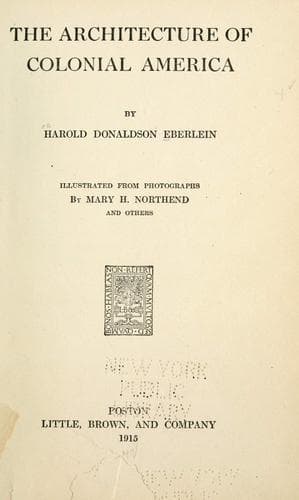
The Architecture of Colonial AmericaEberlein, Harold Donaldson
History
The Architecture of Colonial America
Eberlein, Harold Donaldson
Architecture -- United States; Architecture, Colonial
The history of the plan for the State House is peculiarly interesting
for the light it sheds on contemporary conditions. Determined to erect
the State House, a committee of three was appointed by the Assembly, in
1729, to procure suitable plans. Two members of this committee prepared
plans for the new building, namely Andrew Hamilton and Dr. John
Kearsley, to whom further reference will be made in a following
paragraph. Dr. Kearsley, it is true, had achieved considerable
reputation as an architect by the plans that he had devised for Christ
Church, but Hamilton was not supposed to have any aptitude in that
direction. He was a lawyer, much occupied in the public business of the
Province. It seems, however, that he had mastered some architectural
knowledge while in London where, like so many other illustrious lawyers
of the Middle and Southern Colonies, he received his training in the
Inns of Court. Being a man of remarkable and sterling ability, combining
with his wide versatility and breadth of view a fund of initiative and
force, he generally pushed to a successful completion any matter to
which he addressed himself. His plan, a rough draught on parchment,
which is still to be seen in the collection of the Pennsylvania
Historical Society, was submitted to the Assembly and chosen. For
assurance of the excellence and soundness of his judgment, one has only
to turn their eyes to the fabric of the State House.
In the construction of public edifices, the trials and tribulations of
the eighteenth century architects could well compare with the
difficulties encountered in some instances by their twentieth century
successors. Work on the State House was indeed begun and vigorously
pushed forward by Hamilton so far as he was able, but there were all
sorts of obstructions to be surmounted and drawbacks and hindrances to
be set aside. There were grumbles and growls from influential people who
were either wholly opposed to the undertaking or else dissatisfied with
the site. There were hostile criticisms of the plan adopted, there were
strikes among the workmen, there was, at times, a lack of competent
labour, there were wranglings about the necessary funds to pay the
costs--everything, in short, combined to retard progress and Judge
Hamilton died in 1741 before his plans were fully executed. Although the
date of the erection of the State House is given as 1733--the greatest
portion of it was built then--its completion, as just stated, was not
achieved till eight years later.
Public-domain text, read in full here on John Shaqi.
Reviews
Reviews
No reviews yet
Be the first to share your thoughts on this work.
Elsewhere in the archive
Join the Discussion
Join the discussion
Sign in to leave a comment or review.
Sign InorCreate an account