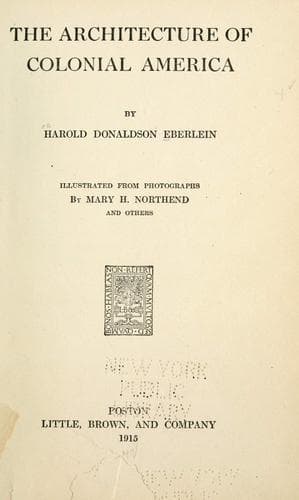
The Architecture of Colonial AmericaEberlein, Harold Donaldson
History
The Architecture of Colonial America
Eberlein, Harold Donaldson
Architecture -- United States; Architecture, Colonial
respect for his materials and a conscientious appreciation of worthy
craftsmanship, inherited by tradition from his mediæval predecessors and
wholly apart from modern commercialism. Pride in his calling impelled
him to the closest personal supervision and painstaking interest. He
would be content with nothing short of the best.
The amateur architects were no mere dabbling dilettanti, flirting with
a polite and amiable penchant for architectural amenities. The best of
them, and those that left the most impressive memorials of their talent
and skill, were, as we shall presently see, busy men of large affairs
and serious interests. They, as well as the master-carpenters, were
thoroughly conversant with the best architectural books of the period
and often had a fair showing of them on the shelves of their own
libraries. More than one of them left standing orders with their London
booksellers to send them, upon publication, such volumes as were most
worth while. Another factor of their fitness is also to be reckoned. It
was not unusual for them to possess training and experience as
surveyors. Indeed, it was almost imperatively necessary for large
landowners to have a knowledge of surveying in order to look properly
after their interests. This training gave them an insight into the
practice of making accurate measurements and draughting and the effect
of such practical and exact education was not without its weight when
they addressed themselves to designing buildings.
One of the most striking and eminent figures among the eighteenth
century amateur architects was the Honourable Andrew Hamilton, “the
day-star of the American Revolution,” as Gouverneur Morris styled him,
sometime Attorney-General of the Province of Pennsylvania, Provincial
Councillor, Speaker of the Provincial Assembly from 1729 and for a
number of successive years afterward and, above all, illustrious jurist
and pleader, whose defence of Peter Zenger, the New York printer, in
1735, redounded to his fame both in England and throughout the Colonies.
He was a man of exceptional and varied attainments, of catholic
cultivation and outlook and endowed with remarkable elegancy of taste.
Amid all the distractions and pressing concerns of an exacting legal and
public career and the many demands involved in the successful management
of a large private estate, he nevertheless found time to devote a good
measure of attention to architectural diversions and left an enduring
monument to his talents in that direction in the State House in
Philadelphia.
Public-domain text, read in full here on John Shaqi.
Reviews
Reviews
No reviews yet
Be the first to share your thoughts on this work.
Elsewhere in the archive
Join the Discussion
Join the discussion
Sign in to leave a comment or review.
Sign InorCreate an account