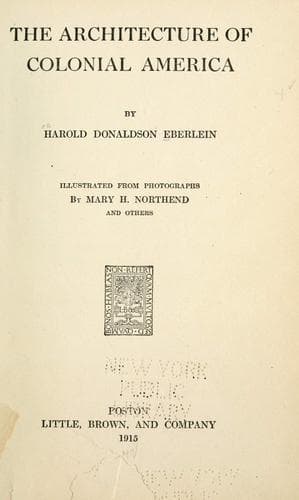
The Architecture of Colonial AmericaEberlein, Harold Donaldson
History
The Architecture of Colonial America
Eberlein, Harold Donaldson
Architecture -- United States; Architecture, Colonial
From the foregoing memoranda it may be seen what manner of man Samuel
Rhoads was and in what esteem he was held by his fellow-citizens. But
what chiefly concerns our present purpose is his connexion, in the
capacity of “carpenter and builder”, with the designing of an
exceptionally fine piece of eighteenth century architecture. When the
Assembly of Pennsylvania, in 1751, passed an act founding the
Pennsylvania Hospital, he was elected a manager by the contributors and
continued on the board for thirty successive years. Ground was secured
and “this purchase being made, a complete plan of the buildings was
directed to be so prepared that a part might be erected, which could be
occupied the ensuing season. [1755.] Samuel Rhoads, one of the managers,
was very zealous in the work and, after consulting the physicians in
regard to the situation of the cells and other conveniences, he
presented a design of the whole building, in such form that one third
might first alone be erected with tolerable symmetry. After due
consideration,” the plan was adopted and, not many years afterward, the
whole design of this carpenter-architect became an accomplished fact to
the lasting satisfaction of succeeding generations.
One of the worthiest of the carpenter-architects was Asher Benjamin of
Massachusetts. Although his work was almost wholly domestic and many of
his commissions would nowadays be classified as “unimportant”, he
nevertheless exerted a markedly beneficial influence upon the
architecture of his day, an influence for which we have reason to be
grateful. He seems to have begun his career as a carpenter in
Greenfield, Deerfield and neighbouring Massachusetts towns. While
working in Greenfield, he published “The Country Builder’s Assistant”,
1796, a book of “simple and practical” scope, containing much suggestive
and useful material. Afterwards, removing to Boston, he published,
partly in collaboration with one D. Raynerd, and partly by himself,
several architectural works of a more ambitious nature. The trade of
carpenter-architect and builder was likewise creditably represented by
numerous other eighteenth century mechanics in New England and the other
parts of the country who, although they did not essay to publish
technical books, were nevertheless far more than mere commercial-minded
artisans perfunctrily “doing the jobs” appointed them and they achieved
the commissions they were entrusted with in a manner to merit the praise
and emulation of modern designers. Nor may we forget the earlier
carpenter-architects of the seventeenth century who created standards of
excellence as a precedent for their successors of the eighteenth
century. Chief among them must be named John Allis of Braintree, born in
1642, who both designed and executed many houses and churches in
Massachusetts in the latter part of the seventeenth century; likewise,
due acknowledgment must be made to John Elderkin, a contemporary of
Public-domain text, read in full here on John Shaqi.
Reviews
Reviews
No reviews yet
Be the first to share your thoughts on this work.
Elsewhere in the archive
Join the Discussion
Join the discussion
Sign in to leave a comment or review.
Sign InorCreate an account