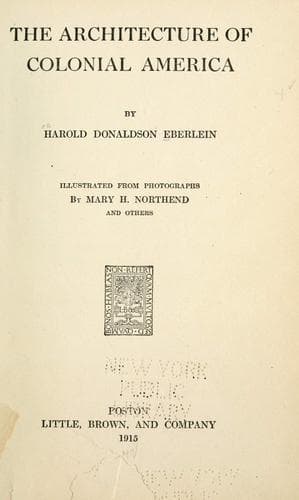
The Architecture of Colonial AmericaEberlein, Harold Donaldson
History
The Architecture of Colonial America
Eberlein, Harold Donaldson
Architecture -- United States; Architecture, Colonial
Allis, who left a deep and beneficial impress upon the architecture of
southeastern Connecticut.
It is exceedingly difficult to draw a sharp line of distinction between
the carpenter-architects and the earliest representatives of the
professionally trained architects whose occupation consisted mainly in
designing buildings and supervising their erection. During the greater
part of the eighteenth century, the many able amateur architects and the
capacity of the carpenter-architects to translate and embody acceptably
in tangible form the conceptions supplied by their employers would
naturally militate against the success of a numerous class of men whose
sole occupation was to design and supervise. It is not at all
improbable, therefore, that some of the men, whom we should be disposed
to regard as the early representatives of the professional architect
class, judging from the importance and visible evidence of the
structures attributed to them, played the rôle of contractors as well
for the erection of the buildings they designed, even though they did
not share in the manual labour. We know, for example, that Richard
Munday first appears in active career as the partner of one Wyatt in a
building or contracting business. His capacity, however, shown by the
Town House or State House in Newport, built from his plans in 1743,
entitles him to a high rank among early American architects.
While some of the early professional architects--the term is not
altogether felicitous but seems necessary for the sake of
differentiating them from the other two classes--were doubtless
self-trained to a great degree, a few appear to have had instruction in
England under competent masters. Notable among them was Peter Harrison,
the architect of the Market or City Hall of Newport, built in 1760, who
was sometime an assistant to Sir John Vanbrugh and is said to have been
a pupil of James Gibbs. McBean, the designer of St. Paul’s Chapel of
Trinity Parish, New York, erected in 1764, is also thought by some to
have been a pupil of Gibbs, although there seems to be no trustworthy
base for such a supposition.
Public-domain text, read in full here on John Shaqi.
Reviews
Reviews
No reviews yet
Be the first to share your thoughts on this work.
Elsewhere in the archive
Join the Discussion
Join the discussion
Sign in to leave a comment or review.
Sign InorCreate an account