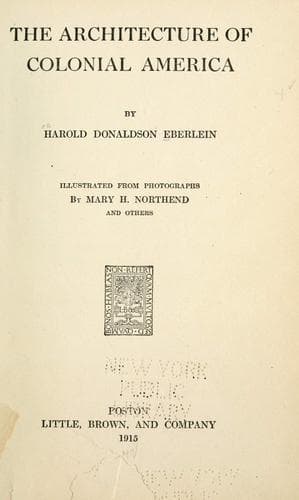
The Architecture of Colonial AmericaEberlein, Harold Donaldson
History
The Architecture of Colonial America
Eberlein, Harold Donaldson
Architecture -- United States; Architecture, Colonial
It is scarcely to be wondered at that a man so endowed by nature,
education and the possession of vast wealth should build in a manner
suited to his condition. In fact it would have been strange if he had
not. But William Byrd was not alone in his enjoyment of unusual
advantages. Although the incidents of his history were not duplicated,
his case was nearly paralleled by other men of his century in the South.
Almost without exception these favoured children of good breeding, to
which was joined the convenience of ample affluence, manifested an
elegant taste and an active personal interest in the building of their
homes and it is to this interest on their part that we of to-day are
indebted for much of what is best in the execution of American Georgian
work. Not a few of the Southern planters were themselves competent
architects but, as representatives of their class in this particular, it
will be sufficient to mention two of them, persons no less illustrious
than George Washington and Thomas Jefferson. Washington always
manifested a deep interest in architecture, is believed to have designed
Pohick Church, had some hand in the plans of Christ Church, Alexandria,
supervised building on his own estates, exercised a directing influence
over the destinies of the public buildings planned or begun during his
lifetime in the Federal City and left an example of his capacity as a
decorative designer in the plastic ornaments of the famous mantel at
Kenmore. How deeply Jefferson was concerned with architectural matters,
both public and private, and how he maintained a lifelong interest in
everything pertaining thereto, an interest that began in early youth and
became stronger with advancing years, we well know. Pressure of onerous
public duties never abated his desire for architectural betterment
throughout the country nor diverted him from using all possible efforts
to secure the realisation of ideals. “Architecture,” he once wrote, “is
worth great attention--the most important of the arts, since it shows so
much.” At another time he penned the following:--“To give buildings
symmetry and taste would not increase their cost, it would only change
the arrangement of the materials, form and combination of members. This
would cost less than the burden of ornament with which these public
buildings are often charged. But the very first principles of the art
are unknown.” These views might find some application not inappropriate
at the present day. Jefferson did not confine his architectural
interests to matters theoretical nor to designing. He was
[Illustration: HARWOOD, ANNAPOLIS, 1774.
Southern Georgian, second phase.]
[Illustration: BRICE HOUSE, ANNAPOLIS, 1740.
Southern Georgian, second phase.]
[Illustration: SHIRLEY, JAMES RIVER, VA.
Southern Georgian, second phase.]
[Illustration: WESTOVER, JAMES RIVER, VA.
Southern Georgian, first phase.]
Public-domain text, read in full here on John Shaqi.
Reviews
Reviews
No reviews yet
Be the first to share your thoughts on this work.
Elsewhere in the archive
Join the Discussion
Join the discussion
Sign in to leave a comment or review.
Sign InorCreate an account