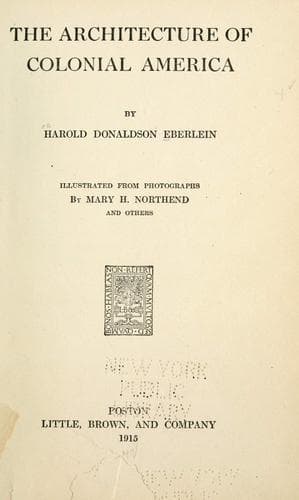
The Architecture of Colonial AmericaEberlein, Harold Donaldson
History
The Architecture of Colonial America
Eberlein, Harold Donaldson
Architecture -- United States; Architecture, Colonial
Architecturally considered, this evolution that culminated in the full
fruition of the Classic Revival shows three influences that are to be
reckoned in any attempt at its analysis. In the first place, there was
the Adam phase of the Georgian mode which had begun to find pronounced
expression in the American Colonies from about 1770 onward. The greater
refinements of this type, as analysed in preceding chapters, were
strongly in evidence up to 1800 or shortly afterward and their Adam
provenance was clearly distinguishable. In the second place, there were
the carpenter-designed and built houses of plainly defined Georgian
ancestry. During the eighteenth century, the public mind had become so
thoroughly imbued with the Georgian spirit of architectural classicism,
tempered and modified, to be sure, by conveyance through a British
medium, but classicism all the same, that even the most unpretentious
little houses gave evidence of the prevailing influence in one form or
another. It might be a house door with pilasters and pediment or it
might be a mantel. The pilasters flanking the doorway might have lost
all traces of near kinship to any of the classic orders, so far as their
details were concerned, and so might the pediment also, but the mere
fact that they were there showed plainly the source whence they were
derived. These carpenter-designed-and-built houses of the end of the
eighteenth century may be regarded as a residuum of the architectural
spirit of the epoch. Last of all, there was the pure classic influence,
the circumstances of whose transplanting to America we shall examine in
detail.
Both the architecture of the Georgian period and the architecture of the
Classic Revival were essentially classic in spirit but there was a vast
difference between their several manifestations of classicality and it
is most important that we should grasp that fundamental difference. The
classicism of Georgian architecture was free in its spirit and
interpretation and was elastic in its adaptability to the requirements
of domestic or public edifices. The architects who applied it were
blessed with common sense and while they incorporated a distinct element
of formal order in their work, they were not trammelled by so narrow a
conventionalism that they feared to make such adaptations as their own
original genius prompted, provided they were consistent with the source
of general inspiration. In other words, the classicism of Georgian
architecture was classicism humanised and rationalised by transmission
through the channels of the Renaissance or the labours of such
discriminating students of antiquity as the Brothers Adam. It was
elastic and suited alike to public edifices and abodes of both high and
low degree. It was also direct and simple and had the dignity and
vitality that art unaffected and ingenuous always shows. For this very
reason it was so convincing and so long retained its hold upon popular
taste.
Public-domain text, read in full here on John Shaqi.
Reviews
Reviews
No reviews yet
Be the first to share your thoughts on this work.
Elsewhere in the archive
Join the Discussion
Join the discussion
Sign in to leave a comment or review.
Sign InorCreate an account