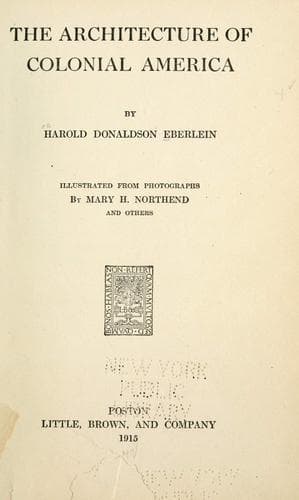
The Architecture of Colonial AmericaEberlein, Harold Donaldson
History
The Architecture of Colonial America
Eberlein, Harold Donaldson
Architecture -- United States; Architecture, Colonial
The classicism of the Classic Revival, on the other hand, was
essentially and unalterably rigid in its adherence to the forms of
antiquity and the archæological manner of applying those forms. It was
not an adaptation, it was, in very truth, a _revival_ of the modes of
two thousand years ago, a gigantic exhibition of architectural
archæology. The strength of Georgian architecture lay in the freedom and
elasticity of its classicism and its ready flexibility to adaptation.
The weakness of the architecture of the Classic Revival was in its
rigidity and inflexible resistance to efforts to adapt it to varied
modern requirements. In the South, it is true, it showed a few traces of
freer interpretation, perhaps because in some cases the artisans were
incapable of rendering the accurate reproductions executed by better
skilled Northern mechanics but, even with this slight allowance, the
stamp of rigidity remained indelible.
Despite a degree of stiffness and pedantry, however, the architecture of
the Classic Revival, in its more felicitous manifestations, displayed
not a little real excellence, stateliness and grace. Many truly
important structures were built during the period of classic ascendancy
and to-day, after years of vicissitude in popular taste, their charm of
grace and quiet dignity is still fresh and enduring and constantly
reminds us of the courtliness of the generation that wisely planned and
achieved them. In its less regulated forms, on the contrary, probably
due to the ambitious contractor rather than to even an inferior
architect, the architecture of the Classic Revival was often unsuitable
in its application, uncomfortable and sometimes ridiculous. In the fore
part of the nineteenth century, classicism became an obsession among
builders whose sole aim seems to have been to transform each city in
the land into a second Athens or Rome. Everywhere could be seen
buildings that, if not planned on classic lines in their interior
divisions or their side elevations, were at least adorned with Greek and
Roman orders. This church or bank was embellished with a portico of
Corinthian columns, that one across the street had a corresponding
portico of severest Doric character while another, perhaps, around the
corner rejoiced in graceful Ionic pillars and, doubtless, just beyond
was a house whose owner took a proper pride in the impeccable purity of
his Tuscan piazza. Sometimes all the orders got inextricably jumbled
together on the same edifice and overrun with a veritable forest of
acanthus leaves and anthemia, and yet the effect was not wholly bad,
however much it might distress a purist, because the builders, in the
exuberance and freshness of their vigour, could not help producing some
vitality, although they were trying to be scrupulously accurate while
expressing themselves in a medium they did not fully understand. These
unseemly mix-ups of architectural botany or botanical architecture,
Public-domain text, read in full here on John Shaqi.
Reviews
Reviews
No reviews yet
Be the first to share your thoughts on this work.
Elsewhere in the archive
Join the Discussion
Join the discussion
Sign in to leave a comment or review.
Sign InorCreate an account