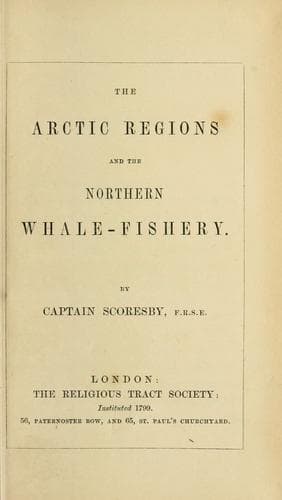
The Arctic regions and the northern whale-fisheryScoresby, William
History
The Arctic regions and the northern whale-fishery
Scoresby, William
Arctic regions; Whaling -- Arctic regions
but even in the laws of a less genial climate, that we are called
upon to observe His eternal power and godhead, who gives the
bounties of his providence to the just and the unjust, and pleads
with us, in the gospel of his Son, that we should be reconciled
to him. The mighty whale, the ephemeral insect, and the minute
animalcule, all the productions of his power and skill, have their
wants supplied by his laws, and are subject to his control. In these
he displays the strength of his arm, and the adaptations of his
wisdom, but in man, redeemed and sanctified, “the exceeding riches
of his grace.” Happy, indeed, are we, if whilst, with the ancient
psalmist, we can proclaim that the earth is full of the goodness of
the Lord, “who gathereth the waters of the sea together as an heap,”
and “layeth up the depth in store-houses,” we can also, without
presumption, through our union with the great heir of all things, the
Lord Jesus, and by the merit of his life and death, honestly declare
all things are ours, whether ... the world, or life, or death, or
things present, or things to come, all are ours, and we are Christ’s,
and Christ is God’s.
CHAPTER VI.
EXPEDITIONS FOR FURTHER DISCOVERY.
Having now completed the account of the Arctic Regions, as given by
captain Scoresby, it may be interesting to the reader to have a brief
statement of some of the principal expeditions for further discovery
down to the present time.
In 1819, lieutenant Parry sailed with the Hecla and Griper. The
object of his expedition was to examine the great and open bay, known
as sir J. Lancaster’s Sound; and, in case of failure, the Sound of
alderman Jones, and that of sir T. Smith. On the 1st of August, the
ships entered the Sound of sir J. Lancaster, and ran quickly up it,
finding no land across the bottom of the inlet, but arriving at a
strait, which they named Barrow’s Strait, and a magnificent opening
into which it led, Wellington Channel. On the 4th of September, the
expedition crossed the meridian of 110° west longitude, in latitude
74° 44′, becoming entitled to a reward of £5,000. They anchored, and
put into winter-quarters at Melville Island, losing sight of the sun
from 11th November till the 3rd of February, when it became once more
visible from the Hecla’s main-top. With the greatest difficulty,
they managed to escape from the ice during the months of August and
September, arriving at the Orkneys 28th October, 1820.
Public-domain text, read in full here on John Shaqi.
Reviews
Reviews
No reviews yet
Be the first to share your thoughts on this work.
Elsewhere in the archive
Join the Discussion
Join the discussion
Sign in to leave a comment or review.
Sign InorCreate an account