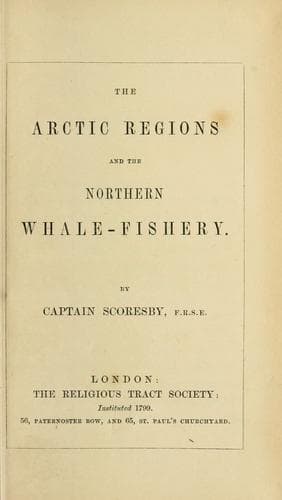
The Arctic regions and the northern whale-fisheryScoresby, William
History
The Arctic regions and the northern whale-fishery
Scoresby, William
Arctic regions; Whaling -- Arctic regions
The second voyage of Parry was with the Fury and Hecla. His
instructions were to proceed towards, or into, Hudson’s Strait, to
penetrate to the westward through that strait, until he should reach
some portion of the coast of the continent of America. The object was
to discover a way westward from the Atlantic into the Pacific Ocean.
The vessels left the Nore 8th May, 1821, and arrived at Resolution
Island, at the entrance of Hudson’s Strait, on 2nd July, attempted
the direct passage through the Frozen Strait, and passed through it
into Repulse Bay. From it no passage was found to the west, and the
ships, after beating about to no profit, were compelled to winter
near Lyon’s Inlet. Here the dreariness of the winter was relieved by
interviews with the inhabitants, who were found to be intelligent
and honest. On 2nd July, the ships left their winter-quarters, and,
after being exposed to the most fearful dangers, arrived at a strait,
called by Parry, the Strait of the Fury and Hecla, and believed by
him to be an opening into the Polar Sea. The ships again went into
winter-quarters, and were frozen in until late in the following year,
but arrived at Lerwick on October 10th, 1823.
The same ships, under the same commander, sailed on a third
expedition in May, 1824, having for its object to penetrate through
Lancaster Sound, Barrow’s Strait, and Prince Regent’s Inlet, to the
westward. Through detention by the ice, they did not arrive at
Lancaster Sound till 10th September, and went into winter-quarters on
the 27th, in Prince Regent’s Inlet, at Port Bowen. On the breaking up
of the ice, they explored, southerly, close to the westward shore;
but by the accidents to which they were exposed, they were compelled
to abandon the Fury, with her stores, and the Hecla only returned to
England.
In 1827, captain Parry proposed to reach the North Pole by means of
travelling with sledge-boats over the ice. Two boats were constructed
for the purpose, the one to be commanded by Parry, the other by
lieutenant Ross. They proceeded in the Hecla to Spitzbergen, and
there left the ship, starting in their sledge-boats with seventy-one
days’ provisions. They travelled by night rather than by day; found
the ice very rough, and in some places tender; and after experiencing
great difficulties, arrived only at latitude 82° 45′, and were
compelled to abandon the undertaking as hopeless.
Public-domain text, read in full here on John Shaqi.
Reviews
Reviews
No reviews yet
Be the first to share your thoughts on this work.
Elsewhere in the archive
Join the Discussion
Join the discussion
Sign in to leave a comment or review.
Sign InorCreate an account