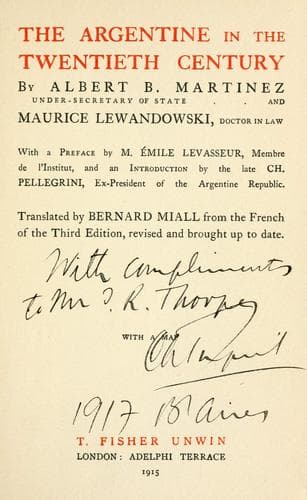
The Argentine in the Twentieth CenturyMartínez, Alberto B.
History
The Argentine in the Twentieth Century
Martínez, Alberto B.
Argentina -- Commerce; Argentina -- Economic conditions; Finance -- Argentina
But, as we have already said, it is in the Pampa——in that vast country
of 56,170 square miles in area——larger than England——which was
incorporated in 1880, after the expedition led by General Roca——that
the most surprising examples of appreciation are to be found. There all
is undergoing a continual transformation; each year the plough opens
wider furrows for the seed; the sowing of lucerne is rapidly increasing;
stock-raising establishments are to be found in the very confines of the
country; and a large network of railways, in operation, in construction,
or under consideration, promise to surround it on every hand, to
circulate its products and to facilitate exchange. All these wonderful
transformations are being effected under our eyes, day by day; so that it
is not surprising that the value of the soil follows this tide of energy.
In the Pampa Central, of late years, we have seen land suitable for
lucerne, with water 10 to 30 feet below the soil, not far from populated
centres, and with means of rapid communication, fetch prices which
quadrupled those it had touched eighteen months earlier, selling for
as much as £3, 11s. 3d. per acre. In more than one case land which was
bought for £880 the square league was afterwards sold for £8800.
Among the sales of 1908 was one of a meadow of 18,525 acres, six miles
from Utracan Station, which, sold by order of the law, fetched a price
of 17s. 10d. per acre. In another part of the same Territory 7698 acres
were sold in a single lot, on the 1st of October 1908, at the rate of £1,
4s. 7d. per acre. In the Alfalfa Colony, during an auction sale, several
_chacras_, or small farms, attained prices varying from £1, 19s. 3d. to
£2, 2s. 9d. per acre.
By the Catrilo railway station on the Western Railway, situated in
the same Territory of El Pampa, is a field whose owner, M. Mathias R.
Sturiza, was offered £61,600 for it; two years earlier he had bought it
for £5280.
Competent authorities assure us that in the neighbourhood of Santa Rosa
de Toay, the capital of the Territory of the Pampa, the value of the
fields has been shown by recent sales to have increased by 300 per cent.
In the department of Victoria, in the same Territory, fields which a
while ago were offered at 2s. 1.5d. per acre, are to-day selling for £1,
1s. 4d.——ten times that sum.
Such are the chief manifestations of the economic phenomena of the
appreciation of land values; one of the most interesting of the problems
which present themselves to the observer of the modern Argentine
Republic. Is it a true symptom of national vitality, or must we see in
these data the warnings of a period of commercial crisis, characterised,
according to the learned economist Juglar, by the rise of all values and
by frantic speculation?
Events, which unroll themselves amidst our feverish Argentine activities
far more rapidly than in other countries, will not be long in giving us
the answer to these questions.[63]
Public-domain text, read in full here on John Shaqi.
Reviews
Reviews
No reviews yet
Be the first to share your thoughts on this work.
Elsewhere in the archive
Join the Discussion
Join the discussion
Sign in to leave a comment or review.
Sign InorCreate an account