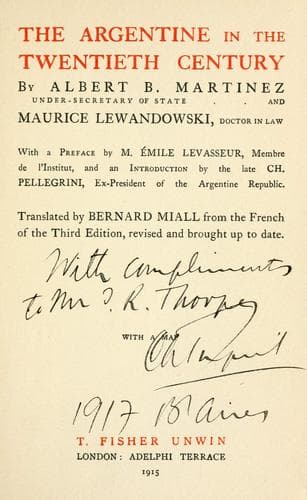
The Argentine in the Twentieth CenturyMartínez, Alberto B.
History
The Argentine in the Twentieth Century
Martínez, Alberto B.
Argentina -- Commerce; Argentina -- Economic conditions; Finance -- Argentina
The result has been an excess of production, which led the industry
into a dangerous crisis, from which it is now in a fair way to recover.
Those who suffered the most were those who had abused their credit by
building expensive factories and laying down costly plant; and those who
had planted sugar in soils unsuited to its culture, or in regions of
unfavourable climate, or where the means of transport were insufficient.
The total area cultivated in 1907 was estimated at about 172,900 acres,
of which 14,029 were in the Province of Tucuman; 11,115 in Southern
Chaco; 6916 in Salta; 3952 in Jujuy, and 2717 in Santiago de l’Estero;
the rest being divided among various other regions of the Republic; these
figures representing an increase of nearly 24,000 acres over those of
1895. These 172,900 acres of cane give an average yield of 30 tons of
sugar per hectare, or 11·727 tons per acre, representing a total yield of
132,160 tons of sugar.
The greatest number of sugar refineries are to be found in the Province
of Tucuman, where there are thirty-two. In the other sugar-growing
districts there are only thirteen, which are distributed as follows:
Three in Jujuy, two in Santiago de l’Estero, one in Salta, one in
Misionès, six on the banks of the Parana River, two in Santa Fé, two in
Corrientès, one in Chaco, and one in Formosa.
The net cost of producing the cane, ready for delivery, is about 5 to
7 centavos[64] per 10 kilograms. Taking as basis a yield of 30,000
kilograms per hectare and a sale price of 12 centavos, the growers would
make a net profit of 140 piastres per hectare; or, with the value of the
piastre note at 2·2 francs, of £4, 2s. 6d. per acre. Thus sugar-planting
is a profitable industry under normal conditions.
[Footnote 64: The centavo is 1/100 or ·01 of the piastre. In metallic
currency it is equal to the American cent, and nearly to the English
halfpenny; in paper it is worth a little over one-fifth of a
penny——·22727 pence.]
The outgoings and receipts on an acre of soil planted with cane may be
estimated as follows:——
RECEIPTS.
By sale of 12 tons of cane, at 12·8d. per
cwt. £12 16 0
EXPENSES.
Public-domain text, read in full here on John Shaqi.
Reviews
Reviews
No reviews yet
Be the first to share your thoughts on this work.
Elsewhere in the archive
Join the Discussion
Join the discussion
Sign in to leave a comment or review.
Sign InorCreate an account