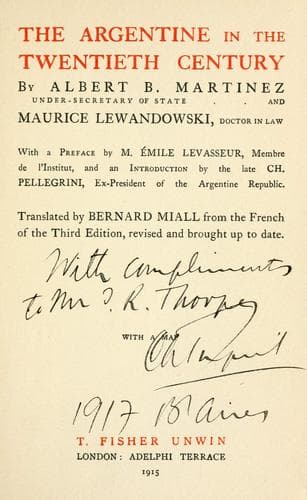
The Argentine in the Twentieth CenturyMartínez, Alberto B.
History
The Argentine in the Twentieth Century
Martínez, Alberto B.
Argentina -- Commerce; Argentina -- Economic conditions; Finance -- Argentina
Of this total an amount of 8724 millions of piastres, or 76·2 per cent.,
applies to metallic operations, which kept speculation alive until the
monetary law of 1899 once and for all arrested the varying values of
paper money. If this law had had no other effect, this result alone would
have justified it as wholly beneficial to the interests of the nation.
In the quotations of the above period mortgage bonds hold the second
place; they represent about 5 per cent.
Being dominated by the spirit of speculation, which expended itself
principally, indeed almost exclusively, upon monetary transactions, the
Bourse had no time to devote itself to more legitimate business. Thus
the public funds represented only some 3 per cent. of this total; then
came shares and debentures of various companies; and last of all banking
shares, the amount of these being insignificant.
The nominal value of all the securities which were quoted on the Buenos
Ayres Bourse in 1907 amounted to $554,791,932 paper and $127,763,525
gold, or an actual total of £74,374,395, and an analysis gives the
following results:——
Dollars (Paper). Dollars (Gold).
Public funds and stocks 157,025,295 35,000,000
National Mortgage Cedulas 129,383,100 11,443,600
Provincial Mortgage Cedulas 129,745,642 ——
Limited Companies: shares 136,657,520 78,416,320
Debentures and certificates 1,980,375 2,903,605
------------ ------------
Totals $554,791,932 $127,763,525
============ ============
These two totals together are equal to a sum of £74,374,395.
In the first edition of this book we gave a summary of the nominal value
of all the stocks quoted on the Buenos Ayres Stock Exchange in 1904; the
sum amounted to 462 millions paper and 38 millions gold, or a total of
£52,256,000; so that in three years these figures had increased by 93
millions paper and 70 millions gold, or over £22,000,000.
It is permissible to hope that in the course of time the Buenos Ayres
Exchange will attain a far greater development, and that it will even
exercise some steadying influence on the prices of the public funds.
To-day their real market is in London, Paris, or Berlin, so that the
credit of the country is affected by the disturbing events of European
markets, while the Buenos Ayres market is devoid of any compensating
effect.
However, it may be observed that when a country begins to grow rich and
to have more assets at its disposal, the public funds placed abroad show
a tendency towards repatriation. We have seen this in the case of Italy
and Austria, which had an important foreign debt in France, and have
considerably reduced it during these last ten years of economic progress.
Public-domain text, read in full here on John Shaqi.
Reviews
Reviews
No reviews yet
Be the first to share your thoughts on this work.
Elsewhere in the archive
Join the Discussion
Join the discussion
Sign in to leave a comment or review.
Sign InorCreate an account