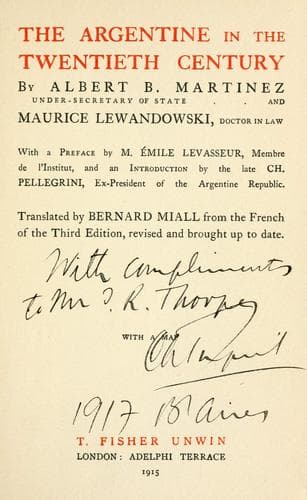
The Argentine in the Twentieth CenturyMartínez, Alberto B.
History
The Argentine in the Twentieth Century
Martínez, Alberto B.
Argentina -- Commerce; Argentina -- Economic conditions; Finance -- Argentina
It will certainly be the same in the case of the Argentine when, thanks
to a series of good harvests, its available or fluid assets have
increased beyond what is absolutely necessary for the development of
agriculture. Investments will be made not only in land or in live stock,
but money will be invested in stocks and shares as well, and notably in
the Government stock of the country.
As a symptom of this tendency, we may mention that interest on the
foreign debt, the coupons for which have hitherto been payable abroad
only, is now payable in the Argentine as well, in order to facilitate
the purchase of this stock in the Republic as a staple investment. The
internal debt is also the object of more extensive operations, now that
the seventeen loans which constituted the old debt have been unified,
and now that a special call is to be made upon the internal credit of
the county with a view to undertaking vast public works. To enlarge the
market for this Government stock the authorities have just decided that
its coupons shall be payable on the principal foreign markets.
Finally, in the course of time the market for industrial stock, bank
stock, and railway shares will gradually become less restricted, in
proportion as the public fortune becomes more extensively subdivided,
instead of being concentrated, as it is at present, in a comparatively
small number of hands. The only thing that may compromise this future is
the excessive speculation which we find, unhappily only too often, in
a country where gambling is a dominant instinct. This excess, with its
natural sequelæ in the form of financial crises, might end by driving all
serious clients from the Bourse, and in destroying the excellent elements
which Buenos Ayres possesses for the creation of an important financial
market.
_Limited Companies._——In the vast progressive movement which increases
in force yearly throughout the Argentine Republic, the Bourse of Buenos
Ayres has yet another part to play: that is, to facilitate the formation
of collectivities of capital under the form of joint-stock companies,
since the spirit of enterprise exhibits itself by preference under this
form. Collective effort is to-day more and more replacing individual
effort; the Argentine must therefore learn how to employ this weapon
of associated capital in order to promote new undertakings, and, by
popularising movable values or securities by the help of the Bourse, to
raise up new resources to the country’s profit.
Our study of the chief manifestations of Argentine life and its
commercial machinery would thus be incomplete if we did not give some
account of the public companies of the Argentine, the legal formalities
demanded of them upon their formation, their mechanism, and the
vicissitudes through which they have passed at various interesting
periods of Argentine history.
Public-domain text, read in full here on John Shaqi.
Reviews
Reviews
No reviews yet
Be the first to share your thoughts on this work.
Elsewhere in the archive
Join the Discussion
Join the discussion
Sign in to leave a comment or review.
Sign InorCreate an account