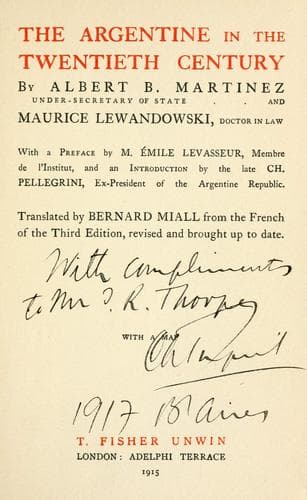
The Argentine in the Twentieth CenturyMartínez, Alberto B.
History
The Argentine in the Twentieth Century
Martínez, Alberto B.
Argentina -- Commerce; Argentina -- Economic conditions; Finance -- Argentina
“Our budgets have constantly increased of late years. It is notorious
that the personnel of the Administration is excessive, just as it is
notorious that useless and expensive sinecures have been created, with
the sole object of giving places to persons whose influence has been
such that the State has undertaken to support them. Bureaucracy is
increasing; industry, commerce, and all the spheres of free endeavour and
of individual effort are abandoned by the sons of the country, who seek
salaried employment or the exercise of intermediary professions which
demand no effort. The number of young men who waste their time in seeking
a place, instead of devoting their activities to work, in a country
which offers wealth to all who will employ a little energy, a little
perseverance, is surprising. But all want an easy life, even though it be
poor and without horizon; all wish to live on the budget, and in order to
gain their object they exhibit all kinds of ingenuity; they go seeking
recommendations, and employ every means at their disposal.
“This host of pertinacious beggars of place results in the creation of
new employments and new services, all equally useless. The national
and provincial administrations pay more than $65,000,000 in salaries
and pensions. Each inhabitant contributes six golden dollars——£1,
4s.——towards the upkeep of an army of employés, which is an enormous
sum. The public services of other countries cost, per inhabitant: in
Switzerland, 4s. 9·6d.; in the United States, 6s. 4·8d.; in England,
8s. 2·88d.; in Holland, 9s.; in Austria, 11s. 2·88d.; in Belgium,
12s. 0·48d.; in Germany, 12s. 0·96d.; in Italy, 15s. 9·6d.; and in
France 19s. 2·88d. These figures, taken from Paul Deschanel’s work on
Decentralisation, show us that we have outstripped all other nations in
the matter of expenditure on the administration; even France and Italy,
where bureaucracy is regarded as a calamity and as one of the causes of
their economic decadence.
“We must check this avalanche by suppressing all useless employments and
all superfluous services. It is essential to turn our young men aside
from their present path, in order that necessity shall force them to
exercise their energies in the vast field which is offered them by a
new country, full of natural wealth, with a fertile soil and a benign
climate.”[96]
[Footnote 96: See _Mémoires des Finances de 1889_, by J. M. Rosa, Vol.
II., p. 174.]
The reaction which Señor Rosa, in his genuine patriotism, had hoped for,
took place a little after his departure from the Ministry of Finance; but
unhappily its direction was the reverse of that he anticipated.
We have examined the expenses of the public administrations; we have
measured the weight of the public debt; we must now examine the treasury
receipts, in order to discover what are the most important sources of the
revenues which fill it, and what elasticity they possess.
Public-domain text, read in full here on John Shaqi.
Reviews
Reviews
No reviews yet
Be the first to share your thoughts on this work.
Elsewhere in the archive
Join the Discussion
Join the discussion
Sign in to leave a comment or review.
Sign InorCreate an account