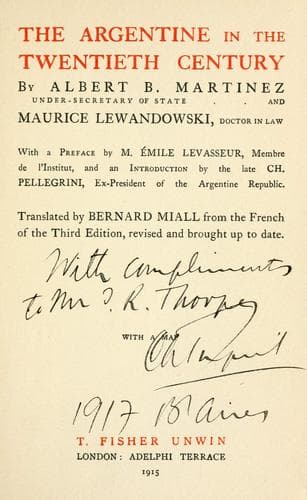
The Argentine in the Twentieth CenturyMartínez, Alberto B.
History
The Argentine in the Twentieth Century
Martínez, Alberto B.
Argentina -- Commerce; Argentina -- Economic conditions; Finance -- Argentina
The “Conversion of Hard Dollars” loan was issued in virtue of the law of
2nd July 1889, which authorised an issue of £2,600,000 to be applied to
the conversion of debts contracted in hard piastres. The new stock was to
yield an interest of 3-1/2 per cent., with 1 per cent. redemption. The
issue actually amounted to £2,659,500.
The “Consolidation Loan” (authorised 24th January 1891) was one of
the most important credit transactions ever effected in the Argentine
Republic: a transaction which evokes memories of a critical period which
we ought briefly to recall.
When Signor Pellegrini’s Government came to power, on the 6th August
1890, the country was suffering from a political upheaval, and at the
same time was entering upon a time of severe financial crisis, “the most
violent, the most desperate crisis which has ever afflicted the Republic,
and put its honour to the test,” according to the words of Vincenzio
Lopez, the eminent finance Minister of that administration.
The Treasury had exhausted its resources, in order to increase and
support the funds of the National Bank, whose debt to the Government
amounted to $47,491,483[104] in paper, and £2,528,224 in gold, while its
debt to foreign creditors amounted to £3,708,037, and to home creditors
£2,328,800.
[Footnote 104: This amount is not reduced to gold, the rate of exchange
not being fixed at the time.——[TRANS.]]
If the situation of the National Bank, which served as the Government’s
treasury, was serious, that of the National Mortgage Bank and that of the
City of Buenos Ayres were no less grave. The first owed $1,690,833 in
paper and £111,475 in gold in dividends, and the second was drained dry
by its debts, amounting to $34,646,533 paper and £92,339 gold at home, as
well as £1,960,000 abroad.
From the outset the Government concentrated all its efforts upon the
solution of these three grave problems. It proposed the reconstitution
of the National Bank; it would enable the Mortgage Bank to continue
operations, chiefly by repaying the advances which it had made to the
State; and assist the City of Buenos Ayres to meet its engagements in
respect of the interest of the foreign debt, constraining it to collect
and employ the municipal revenues in a more methodical manner.
The prime object of this important transaction was “to give the country
a period of economic repose, by provisionally suspending the removals
of metallic currency for the liquidation of the nation’s foreign
engagements,” as the Government declared in the message which accompanied
its proposal. To achieve this end, the creation of a consolidation
loan was proposed, amounting to £12,000,000, and increased later on to
£15,000,000 upon the advice of the lenders, the result being destined,
for a period of three years, for employment in paying the interest
on the nation’s loans and in relieving the Treasury of the burden of
guaranteeing the dividends of the railways.
Public-domain text, read in full here on John Shaqi.
Reviews
Reviews
No reviews yet
Be the first to share your thoughts on this work.
Elsewhere in the archive
Join the Discussion
Join the discussion
Sign in to leave a comment or review.
Sign InorCreate an account