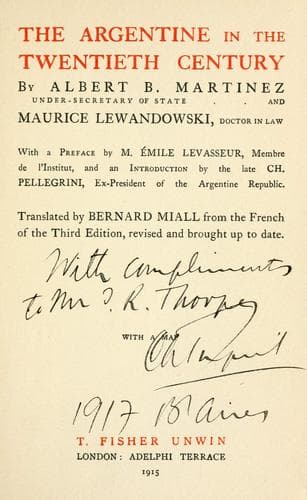
The Argentine in the Twentieth CenturyMartínez, Alberto B.
History
The Argentine in the Twentieth Century
Martínez, Alberto B.
Argentina -- Commerce; Argentina -- Economic conditions; Finance -- Argentina
In accordance with agreements concluded between the Government of the
Republic and the banking houses which undertook to negotiate the loan,
the banks undertook to accept, during a period of three years, as
consideration for the debt, and for the effectual guaranteeing of the
railways, bonds of the loan itself; and undertook, moreover, to accept
them at par. The issue each year was to be proportional to the sum
necessary to pay the interest on the debt.
The nation, on the other hand, undertook to set aside for the payment
of the interest on the said loan 6 per cent. of the customs receipts,
which were subjected to a monthly levy of the amount required, the amount
affected by the prior rights of the loan of 1885 being deducted first.
The nation also engaged not to increase its foreign debts, whether by
borrowing or giving guarantees, during the three years fixed for the
issue of the loan.
The total amount authorised was £15,000,000, the interest 6 per cent.,
and redemption was to commence at the end of three years, to be completed
in thirty years. Coupons could be paid to the State in settlement of
customs duties. Of the above nominal sum, only £7,691,725 was actually
raised, £7,308,275 remaining unissued for the following reasons:——
Under the administration of Señor Saenz Peña, when Señor Romero was
installed in the Ministry of Finance on the 12th October 1892 he found
the Consolidation Loan in process of issue, the stock being sold at need,
the 6 per cent. bonds being guaranteed by the customs receipts; they were
then selling in London at about 63 per cent. Señor Romero estimated that
if the system of paying debts by means of debts is generally a ruinous
one, it was especially so in this case, where the transaction was being
effected by means of bonds so badly depreciated as those of this loan.
The first important act of this Presidency was to make an arrangement
with the representatives of the bearers of the foreign debt, by which
they consented to a reduced interest for five years——that is, until
1898——the redemption charge being suspended simultaneously. In the
following years, from 12th July 1898 to 12th January 1901, the full
interest alone was to be resumed, and from 1901 the payment of the
redemption charge would also be resumed.
As a consequence of this arrangement, it was decided to issue no further
stock of the loan, even in cases where the issue was authorised: as,
for example, in the effective guarantee of railway stock. Holders of
the latter would receive payment on the basis of the price at which the
shares were quoted. This is why the Consolidation loan issue of 1891 was
confined to the sum already cited.
The “Travaux de salubrité,” or Water Supply and Drainage loan, authorised
by the law of 30th January 1891, to the extent of £6,750,000, in bonds
bearing 5 per cent. interest and 1 per cent. redemption, was created
under the following conditions:——
Public-domain text, read in full here on John Shaqi.
Reviews
Reviews
No reviews yet
Be the first to share your thoughts on this work.
Elsewhere in the archive
Join the Discussion
Join the discussion
Sign in to leave a comment or review.
Sign InorCreate an account