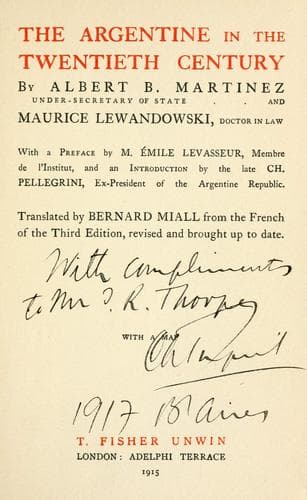
The Argentine in the Twentieth CenturyMartínez, Alberto B.
History
The Argentine in the Twentieth Century
Martínez, Alberto B.
Argentina -- Commerce; Argentina -- Economic conditions; Finance -- Argentina
The Government of Señor Juarez Celman, which preceded that of Signor
Pellegrini, was inspired by the Spencerian doctrine, which asserts as a
principle that the State is always a bad administrator, and fell into
financial and administrative errors which were to cost the country dear
indeed. Thus it resolved to place in the hands of individuals all the
industrial enterprises undertaken by the nation, among which was the
scheme for supplying the city of Buenos Ayres with water and facilitating
the elimination of its filth and sewage.
Every one very soon saw, however, that a serious mistake had been
made. The individual firm entrusted with these important services was
exclusively preoccupied in exploiting the public, and its methods
resulted in protests and resistance on the part of the inhabitants
of Buenos Ayres. On 6th August 1890, the Government, Pellegrini
being president, came to the conclusion that it was its duty as an
administration, and was also a matter of political efficiency, to place
the sanitation works in the hands of the State once more; and with this
object it obtained an authorisation to contract a loan of £6,750,000, at
5 per cent. and 1 per cent. redemption. Such was the origin of this loan,
of which stock to the value of £6,374,995 was issued.
The “Rescission of Railway Guarantees” loan, authorised by the laws of
10th January 1896 and 30th December 1898, was contracted to disburthen
the State of the heavy obligations which weighed upon it as a result
of having guaranteed an interest of 6 per cent. on enormous capitals
employed in the construction of railways. With this object £11,699,957
worth of stock was created, and issued at 4 per cent. and 1/2 per cent.
The loan for the “Conversion of Provincial Debts,” created by the law of
8th August 1896, was justified by the highest considerations of national
solidarity, and of the defence of Argentine credit abroad.
The enormous debts contracted by the Provinces, unauthorised and
uncontrolled by the central power, quickly resulted in a veritable
bankruptcy, at the end of a period of waste and folly, of unchecked and
uncalculating expense.
The nation, which had in no way intervened in the matter of these
loans, and had contracted no obligations whatever on their behalf,
might strictly have refused to accept any responsibility for such heavy
liabilities; but it is indubitable that the insolvent condition of the
Provinces in the European markets might have affected the credit of
the nation, the latter being, in foreign eyes, involved in all these
individual failures.
What President Quintana said in his inaugural address on the subject of
the peace of the Provinces, which is also the peace of the State, may
also, with no less reason, apply to credit.
Public-domain text, read in full here on John Shaqi.
Reviews
Reviews
No reviews yet
Be the first to share your thoughts on this work.
Elsewhere in the archive
Join the Discussion
Join the discussion
Sign in to leave a comment or review.
Sign InorCreate an account