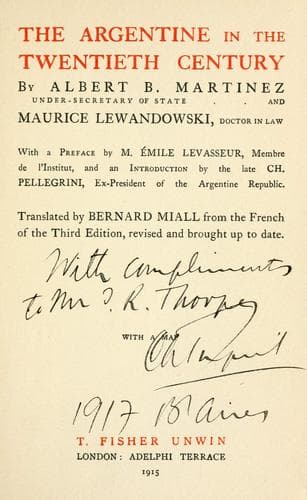
The Argentine in the Twentieth CenturyMartínez, Alberto B.
History
The Argentine in the Twentieth Century
Martínez, Alberto B.
Argentina -- Commerce; Argentina -- Economic conditions; Finance -- Argentina
Argentine 4 per cent. Gold Bonds (1900): Authorised, £2,828,515; issued,
£2,752,855. Price on 1st January 1910, 91.
Argentine Cedulas, Series B. (1886). These are certificates to bearer
issued by the National Mortgage Bank in lieu of cash lent to borrowers
on real estate. They were first issued in 1886, when a total of
$50,000,000 was issued in three series, A, B, and C. They are redeemable
by sinking funds of 1 per cent., and under Article 60 of its organic law
the National Mortgage Bank has to add to these funds the sums in cash
received from its debtors on account of advances of capital or sale of
properties. Cedulas are guaranteed by the nation.
In circulation, 31st August 1909, $1,175,250. Cancelled. $13,824,750.
Interest, 7 per cent. Prices have varied from 24-1/4 to 48-3/4. Price on
1st January 1910, 44-1/2.
Buenos Ayres Water Supply and Drainage Bonds (1892). Authorised,
£6,324,400. Present amount, £5,620,820. The operation of the Sinking Fund
in January 1910 will further reduce this amount. Prices have varied from
52-3/8 to 106. Price on 1st January 1910, 106.
Buenos Ayres Sterling Bond 3 to 3-1/2 per cent. Authorised, £10,296,000;
issued, £9,796,000. Price on 1st January 1910, 69-3/4.]
Although the Minister who effected this operation, exceeding the advice
of competent persons, or rather defying their judgment, took it upon
himself to issue a fervent panegyric of his transactions in an official
document, we none the less consider that the fundamental defect of
this conversion lay in having largely reduced the amortisation rate
of some of these loans, bringing them down from 6 per cent., 4 per
cent., 3 per cent., and 2 per cent., to a uniform rate of 1 per cent.;
as the sinking-fund, as a general thing, in the case of all financial
administrations, and especially of those of a country without any
great experience of government, is a restraining factor, a limit which
Governments and Parliaments impose upon themselves, in order not to
spend all they collect. Without this money-box, this “woollen stocking”
of Governmental savings, as M. Neymarck called it, it is certain that
there would be no trace in the Argentine Treasury of all the millions it
has paid in amortisation during the last few years; so that the present
generation would have cast upon the shoulders of the coming generation a
far heavier burden than that the latter will inherit as things are.
Returning to the external debt, we may state that among the loans
which figure in the national liabilities are eight, with a capital of
£23,350,139, at 5 per cent. interest; two, with a capital of £7,697,263,
at 4-1/2 per cent.; eleven with a capital of £29,840,315, at 4 per cent.,
and one of £2,004,710 at 3-1/2 per cent.
The public debt, external and internal, amounts to the following:——
External debt £62,892,428
Internal debt 16,839,365
-----------
£79,731,793
Public-domain text, read in full here on John Shaqi.
Reviews
Reviews
No reviews yet
Be the first to share your thoughts on this work.
Elsewhere in the archive
Join the Discussion
Join the discussion
Sign in to leave a comment or review.
Sign InorCreate an account