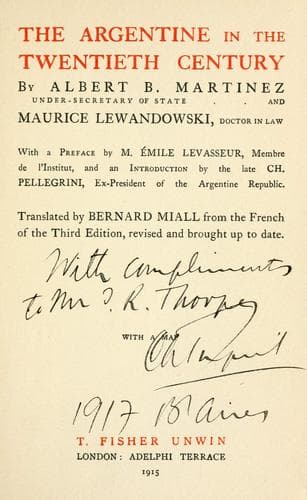
The Argentine in the Twentieth CenturyMartínez, Alberto B.
History
The Argentine in the Twentieth Century
Martínez, Alberto B.
Argentina -- Commerce; Argentina -- Economic conditions; Finance -- Argentina
Let us see to what extent the interest on this debt weighs upon the
Budget:——
External debt £3,794,436
Internal debt 1,004,445
——————————
Total on 1st January 1909 £4,798,881
——————————
In the tabulation of the foreign debt we have not included the new loan
of £10,000,000, the stock being known as “Argentine Internal Credit,
1909,” bearing 5 per cent. interest and a 1 percent. consolidated sinking
fund, which the national Government has just raised in Europe. This loan,
which was readily taken up, was divided in the following proportions:
England, £2,960,000; France, £3,200,000; the United States, £2,000,000;
Germany, £1,640,000.
Taking this new loan into account the total of the external debt is
£72,892,428.
The various amounts of interest payable on the whole National Debt,
external and internal, converted into gold at the rate of 4s. per
piastre, represent a total of £4,778,882. As we have stated before, this
burden does not weigh exclusively on the Treasury; we must deduct from
it the interest paid by the Provinces and the National Bank, or, a sum
of £687,628, so that the interest paid by the nation amounts in fact to
£4,111,253. Comparing this figure with the total of the general budget,
we find that the interest on the National Debt amounts to 25·34 per cent.
of the total expenditure, of which 22·3 per cent. weighs exclusively on
the nation. Finally, we must not forget that large sums included in the
budget are paid into the sinking fund at a rate which should rapidly
decrease the debt; a factor which evidently must be reckoned as a
compensation.
In the face of this enormous debt are we to conclude, with certain
authors of repute, that when the payment of the interest on the public
debt absorbs more than 40 per cent. of a nation’s revenue, that nation is
in the most serious situation, not far removed from bankruptcy?
Certainly the theories of these gentlemen are based upon valuable data,
which are deduced from the science of finance, or taken from the actual
examples of certain nations; but it is also certain that these theories
have been formulated with the mind directed toward European countries,
in which population, wealth, and all the phenomena of social life are
evolved in a slow and harmonious manner; but for countries like the
Argentine, countries with enormous natural resources, subject to sudden
increases of wealth and population, where all manifestations of progress
are abrupt, such theories are not true.
Public-domain text, read in full here on John Shaqi.
Reviews
Reviews
No reviews yet
Be the first to share your thoughts on this work.
Elsewhere in the archive
Join the Discussion
Join the discussion
Sign in to leave a comment or review.
Sign InorCreate an account