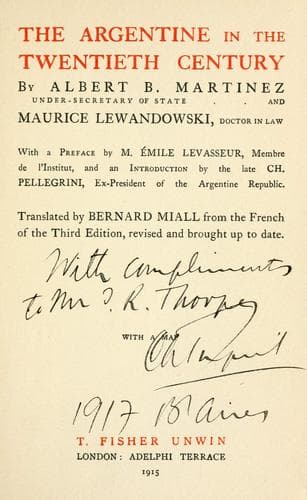
The Argentine in the Twentieth CenturyMartínez, Alberto B.
History
The Argentine in the Twentieth Century
Martínez, Alberto B.
Argentina -- Commerce; Argentina -- Economic conditions; Finance -- Argentina
In 1861 the depreciation of paper touched its lowest point: 2483 piastre
notes were given for $100 in gold. The premium was thus 2383 per cent.
But the reader must not take this to be the only surprise that the
history of the double standard has in store; others, still greater,
remain to be told. In 1862 the depreciation was even lower, the premium
reaching 2456 per cent., and 2556 piastre notes being given for $100 in
gold.
The premium continued to rule high until 1867, being 2569 per cent. in
1863; 2784 per cent. in 1864, 2597 per cent. in 1865, and 2406 per cent.
in 1866.
We stated just now that the Republic, during a long period of history,
never escaped from the inconveniences of depreciated paper save
practically on two occasions, which were unhappily of only too short
a duration. The first occasion was when Adolfo Alsina was Governor
of the Province of Buenos Ayres. The “Bureau of Bank Exchanges” was
established, its mission being to exchange one piastre in gold against 25
in paper, and _vice versa_. This Bureau was in operation from February
1867 to May 1876, the date of the suspension of metallic conversion.
After this period the value of paper money declined anew. In May 1876
the golden coin was worth 28 piastre notes; in June, 30; in July, 33; in
December, 29.
In 1877 the average value of a golden piastre was 29 piastre notes; that
is, 100 piastres in gold represented 2900 notes; in 1878 the ratio was
3187; in 1879, 3220; in 1880, 3055; in 1881, 2706.
It was at this time that the second exception occurred, marking another
check to the constant depreciation of paper.
In November 1881, under the Presidency of General Roca, Señor Romero
being Minister of Finance, a law was promulgated establishing a
bimetallic standard in the Argentine. The monetary unit was to be the
piastre of gold or of silver; the first weighing 24.9 grains Troy, and
the second 383.8 grains, both being alloys containing nine-tenths of
the pure metal. This law also established the metallic conversion of
depreciated notes.
This operation was a beneficent advance in the economic and financial
system of the country; for by establishing metallic conversion it gave
stability to the legal instrument of monetary transactions, and also
contributed to establish an enviable state of affairs during the years
1883 and 1884, which gave rise to the rosiest hopes for the future. But
by an irony of fate the very Government which had suppressed the double
standard found itself forced to re-establish it in January 1885. It
should be remarked that at this time Señor Romero was no longer Minister
of Finance.
The country being once more abandoned to the miserable system of
inconvertibility, the depreciation of paper began its downward progress,
recalling the too celebrated case of the _assignats_, a case one would
have thought impossible of recurrence in time of peace and among a people
that had suffered no catastrophe for many years.
Public-domain text, read in full here on John Shaqi.
Reviews
Reviews
No reviews yet
Be the first to share your thoughts on this work.
Elsewhere in the archive
Join the Discussion
Join the discussion
Sign in to leave a comment or review.
Sign InorCreate an account